What Is the Best Ratio for Making Coffee?
I’ll never forget the first time I made a French press for friends. I remember feeling downright sophisticated—standing there, kettle in hand, pouring hot water over fresh grounds like I knew exactly what I was doing. The reaction was perfect. Impressed. Curious. Expectant.
Then came the plunge.
The smiles faded fast. I took a polite sip, nodded like everything was fine, and silently accepted the truth: I had made a cup of mud.
That moment sent me down the rabbit hole of coffee ratios—and if you’ve ever brewed something that looked right but tasted wrong, you’re already halfway there too.
Let’s make sure your next French press, pour-over, or drip brew doesn’t end the same way.
What Coffee Ratios Actually Mean (And Why They Matter)
A coffee ratio is simply the relationship between coffee grounds and water, measured by weight. It’s the backbone of consistent brewing—and the reason your coffee tastes wildly different from one cup to the next if you’re eyeballing it.
If you’re just getting serious about brewing at home, this guide pairs well with the broader fundamentals covered in home coffee brewing methods and basics, which is where we’re building out deeper how-to content over time.
Ratios aren’t about being fancy. They’re about control.
Once you understand ratios, you can:
Fix weak or bitter coffee
Adjust strength without guessing
Recreate great cups consistently
The “Perfect” Coffee Ratio (Short Answer: There Isn’t One)
There’s no universal best ratio—only a starting point.
For most brewing methods, a solid baseline sits between 1:15 and 1:17
That means 1 gram of coffee for every 15–17 grams of water.
From there, you adjust based on:
Brew method
Grind size
Bean freshness
Personal taste
If your coffee tastes hollow, go stronger. If it’s harsh or muddy, back it off.
What You’ll Need to Dial In Ratios Correctly
You don’t need café-grade gear, but a few basics help a lot:
A kitchen or coffee scale
Freshly roasted coffee beans
Good-quality water
A consistent brewing method
If you’re still building confidence, this pairs well with how to make good coffee at home, which walks through fundamentals without overcomplicating things.
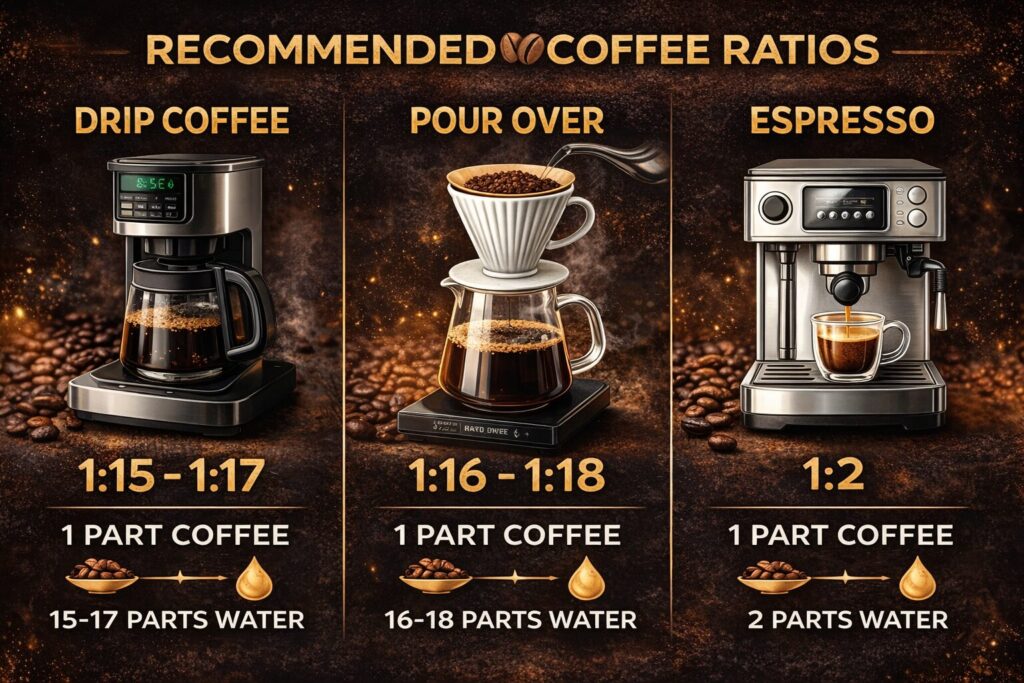
Recommended Coffee Ratios by Brew Method
Drip Coffee
Ratio: 1:15 to 1:17
Drip coffee lives and dies by balance. Too strong and it’s bitter. Too weak and it tastes flat. Staying in this range gives you a clean, familiar cup that works for most automatic brewers.
If your drip coffee still feels thin, this breakdown on how to make strong coffee at home can help you adjust strength without over-extracting.
Heat the milk slowly. Don’t boil it. Don’t froth it like a cloud. You’re not chasing height—you’re chasing smoothness.
Whole milk gives the most classic café flavor.
Oat milk adds a slightly sweet, buttery note that fits the spices beautifully.
If you’re particular about ratios, the guide from What Is the Best Ratio for Making Coffee? helps you find the balance between sweet, spiced, and strong.
Pour Over
Ratio: 1:16 to 1:18
Pour-over rewards patience and precision. Lighter ratios help highlight clarity, acidity, and origin flavors—especially with single-origin beans.
If you’re working with a V60 specifically, this Hario V60 pour-over guide pairs perfectly with these ratios.
Espresso
Ratio: 1:2
Espresso plays by different rules. A standard shot uses a 1:2 ratio, meaning 18 grams in and about 36 grams out. Small changes here have big effects on flavor, body, and balance.
If you’re curious how espresso strength compares to brewed coffee, is espresso stronger than coffee clears up a lot of common misconceptions.
Ratios Are Guidelines—Taste Is the Goal
Ratios give you structure, not handcuffs.
Once you understand the standards, feel free to bend them. Some days you want bold and heavy. Other days, clean and light. Coffee should move with your mood, not fight it.
This article is meant to anchor your understanding—but it’s only one piece of the bigger picture we’re building across home coffee brewing as a dedicated knowledge hub.
Learn the ratios. Break the rules. Drink better coffee.
How to Use Coffee Ratios to Brew Better Coffee Every Time
Coffee ratios aren’t about chasing perfection—they’re about consistency. Once you understand how coffee and water work together, you stop guessing and start brewing with intention. The ratios in this guide give you a reliable starting point, whether you’re using a drip machine, French press, pour over, or pulling espresso at home.
From here, the real work (and fun) begins. Adjust slightly. Taste everything. Take notes if you’re inclined, or just trust your palate. Over time, you’ll learn exactly how strong, clean, or bold you like your coffee—and you’ll be able to recreate it without thinking twice.
As we continue building out the Home Brewing section, this page serves as a foundation. Come back to it when you change beans, switch brew methods, or something tastes off. Coffee rewards attention, and ratios are one of the simplest ways to level up without overcomplicating the process.
Want More Coffee Recipes?