Best Affordable Espresso Machines: Honest Picks from $65 to $700

best affordable espresso machines
Disclosure: Coffee Slang is reader-supported. Some links on this page are Amazon affiliate links — if you buy through them, I earn a small commission at no extra cost to you. I only recommend machines I've researched thoroughly or used personally.

☕ Quick Answer: Best Affordable Espresso Machines

  • Best overall under $300: Gaggia Classic Pro — real espresso, upgradeable, lasts a decade
  • Best beginner semi-auto: DeLonghi Dedica EC685 — slim, forgiving, under $200
  • Best manual/lever pick: Flair Classic or Flair 49 Pro — no electricity, barista-quality shots
  • Best pod comparison: Nespresso Vertuo Next — fast and consistent, but you're locked into pods
  • Best portable: Wacaco Picopresso — pro-grade espresso in your backpack
  • Best splurge picks ($500–$700): Breville Bambino Plus or Barista Express

Espresso machines have a reputation for being expensive, complicated, or both. That reputation is mostly wrong — or at least, it doesn't have to be your reality. The machines on this list prove that you can pull a genuinely good shot at home without spending $1,000 or going to barista school.

I've pulled shots on every type of machine in this guide — from lever presses to semi-automatics to Nespresso pods — and what I've learned is that the best machine for you depends almost entirely on how involved you want to be. Some people want to press a button. Others want the ritual. This guide covers both ends of that spectrum and everything in between.

Before You BuyYour grinder matters as much as your machine. A $150 machine with a quality burr grinder will consistently outperform a $500 machine paired with a blade grinder. If you're serious about espresso, budget for both.

How We Picked These Machines

This list focuses on machines under $700, with emphasis on the $100–$300 range where the real value lives. Every pick is evaluated on shot quality, durability, ease of use, and how honest the price-to-performance ratio actually is.

Machines are divided into four tiers: ultra-portable picks, the sub-$300 sweet spot (manual and semi-auto), a pod comparison pick, and splurge options for buyers who want to step up without crossing into prosumer territory. I've also included a full comparison table so you can cut straight to the specs that matter.


Full Comparison Table

Machine Price Type Pressure Milk Steaming Best For
Wacaco Nanopresso ~$65 Manual portable 18 bar None Travel / camping
Wacaco Picopresso ~$130 Manual portable 18 bar None Pro-level on the go
Flair Classic ~$149 Manual lever 6–9 bar None Hands-on home espresso
Flair 2GO ~$149 Manual lever (portable) 6–9 bar None Travel + home hybrid
DeLonghi Dedica EC685 ~$180 Semi-automatic 15 bar Steam wand Beginner, small kitchen
Nespresso Vertuo Next ~$130 Pod (capsule) 19 bar centrifusion None (Aeroccino sold separately) Convenience-first
Flair 49 Pro ~$299 Manual lever 6–9 bar None Serious manual brewing
Gaggia Classic Pro ~$449 Semi-automatic 9 bar Commercial steam wand Enthusiast starter machine
Breville Bambino Plus ~$499 Semi-automatic 9 bar Auto steam wand Beginner-to-intermediate
Breville Barista Express ~$699 Semi-auto + built-in grinder 9 bar Manual steam wand All-in-one setup

Ultra-Portable Picks (Under $150)

These aren't compromise machines. Both Wacaco models are genuinely capable of producing real espresso — crema included — with nothing more than hot water, ground coffee, and your hands. They're the right choice if you travel frequently, have a tiny kitchen, or want to try manual espresso before investing in a countertop machine.

Under $100 — Travel Espresso
Wacaco Nanopresso portable espresso maker
Wacaco Nanopresso
Best Travel Pick
~$65 on Amazon
The Nanopresso is the easiest entry point into manual espresso. It's piston-operated — you pump by hand to build pressure — and at 18 bar it technically exceeds most home machines. The shots are closer to moka pot than a true espresso bar, but there's genuine crema and real body. At $65, nothing else at this price comes close for actual espresso (not just strong coffee).
18 bar max 0.74 lbs No electricity Ground coffee 70ml water capacity
~$130 — Pro-Level Portable
Wacaco Picopresso portable espresso maker
Wacaco Picopresso
Pro Portable
~$130 on Amazon
The Picopresso is Wacaco's most serious machine — it uses a commercial-sized 52mm naked portafilter and an 18g basket, the same format you'd find in a café. There are no shortcuts here: you need a quality burr grinder, proper tamping, and good technique. In exchange, you get shots that rival countertop machines that cost four times as much. It's not beginner-friendly, but for an experienced coffee drinker who travels, it's remarkable.
18 bar max 52mm portafilter 18g basket No electricity Naked portafilter

Manual Lever Machines ($149–$299)

Flair makes some of the most interesting espresso machines at any price point. They're fully manual — no pumps, no boilers, no electricity — which means you control every variable in the shot. That's either exciting or annoying depending on your personality. If you like the ritual of coffee making, a Flair is one of the most satisfying pieces of gear you can own. If you want espresso in 30 seconds without thinking about it, look elsewhere.

Flair Requires a Burr GrinderAll Flair machines need freshly ground coffee at an espresso-fine setting. A quality burr grinder is non-negotiable — a blade grinder will produce inconsistent, uneven shots. Budget for a grinder when pricing out a Flair setup.
~$149 — Manual Lever (Home)
Flair Classic espresso maker
Flair Classic
Best Manual Pick
~$149 on Amazon
The Flair Classic was updated in 2025 and is now better than ever — two portafilters (one for beginners, one for advanced brewing), an integrated pressure gauge, and a heat-efficient brew cylinder, all for $149. It's 100% human-powered: you add hot water to the brew cylinder, tamp your grounds, and press the lever. The pressure gauge tells you exactly where you are in the extraction. The shots, when dialed in, are genuinely excellent — dense, sweet, with thick crema.
6–9 bar No electricity Pressure gauge 2 portafilters Cast aluminum + stainless
~$149 — Portable Lever (Travel + Home)
Flair 2GO portable espresso maker
Flair 2GO
Travel + Home
~$149 on Amazon
The 2GO is Flair's most portable machine — it folds flat using six pivot points and fits into a case the size of a hardback book. At under 3.6 lbs, it goes anywhere. The Grounds model uses a bottomless 2-in-1 portafilter for the same dialed-in experience as the Classic; the Pods model accepts Nespresso Original pods for convenience on the road. The pressure gauge is included on both. If you want a Flair you can take camping or to a hotel room, this is the one.
6–9 bar Collapsible frame Under 3.6 lbs Grounds or Pods model Pressure gauge
~$299 — Best Manual Under $300
Flair 49 Pro espresso maker
Flair 49 Pro
Best in Class
~$299 on Amazon
The 49 Pro is Flair's best all-manual machine — a full all-metal frame, 49mm handled portafilter with two baskets (beginner and advanced), and a pressure gauge, all in one package. The larger portafilter size over the Classic gives you more surface area for even extraction, and the handled design makes it feel closer to a traditional home machine. It sits at the top of the under-$300 tier for manual brewing, and it's the machine I'd recommend if you're serious about learning espresso without going electric.
6–9 bar 49mm portafilter All-metal frame 2 baskets included Pressure gauge

Semi-Automatic Picks (Under $300)

Semi-automatic machines do the pump work for you — push a button, pull a shot. They have a boiler or thermoblock that heats water, a pump that drives pressure through the portafilter, and most include a steam wand for milk drinks. For beginners who want espresso without the manual lever learning curve, this is the right category.

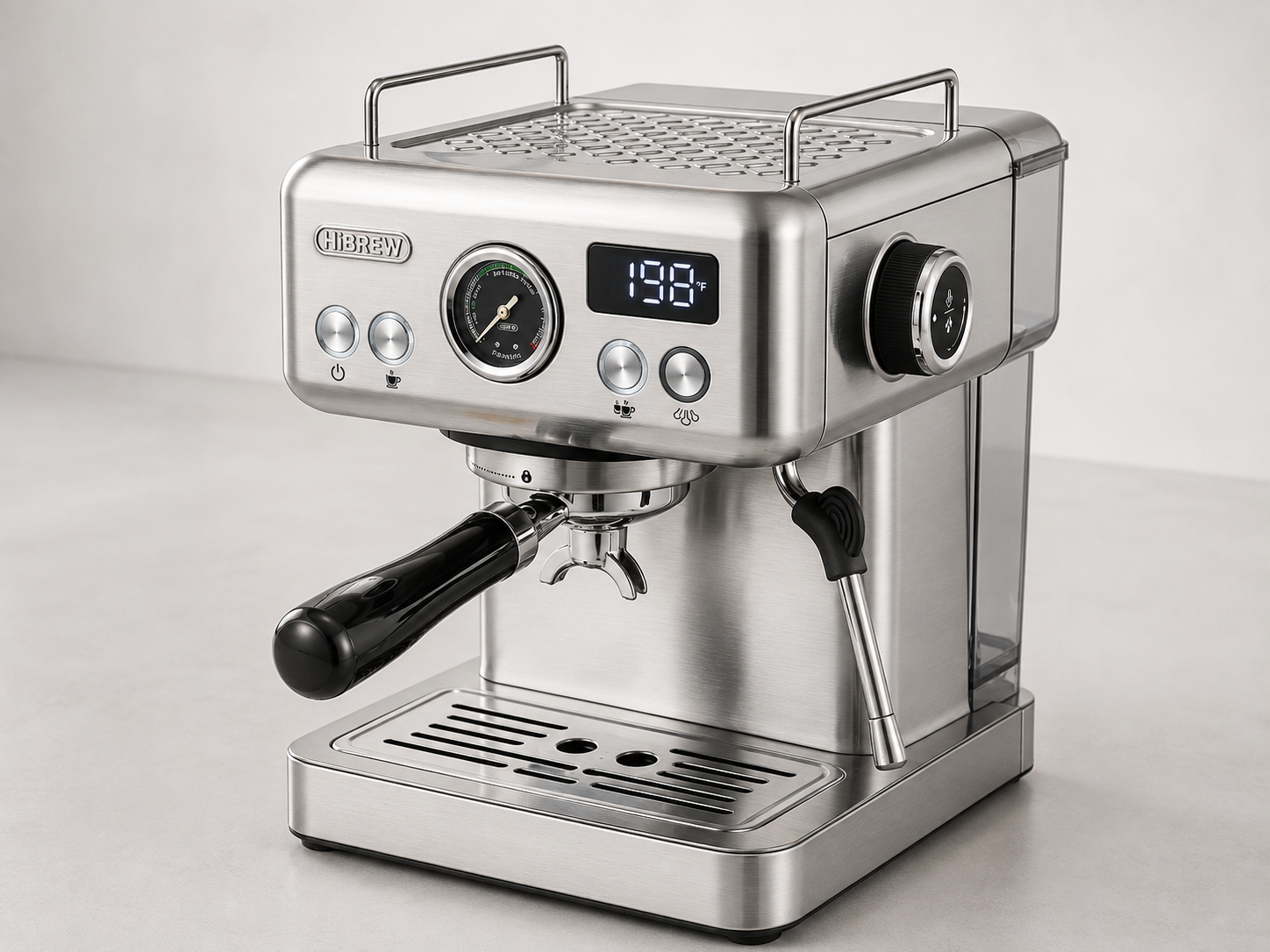
~$180 — Best Beginner Semi-Auto
DeLonghi Dedica EC685 espresso machine
DeLonghi Dedica EC685
Best Beginner Pick
~$180 on Amazon
The Dedica is 6 inches wide — thinner than most toasters — which makes it the go-to machine for anyone with a small kitchen. It pulls a solid shot with a thermoblock heating system that's ready in under 40 seconds, has a steam wand for lattes and cappuccinos, and accepts both ground coffee and ESE pods. It's not a machine for espresso nerds (the pressurized portafilter is forgiving but limits control), but for someone moving from Nespresso to actual espresso, it's a natural first step with a gentle learning curve.
15 bar pump 6" wide footprint Steam wand Ready in ~40 sec Ground + ESE pods

Pod Comparison: Nespresso Vertuo Next

I'm including a Nespresso here not because it's the best espresso option, but because it's the most common point of comparison for people entering this category. A lot of buyers are deciding between a Nespresso and a real espresso machine — and that's a legitimate question worth answering directly.

⚠️
Pod Lock-InNespresso Vertuo uses a proprietary capsule system — you can only use Nespresso's own pods. Third-party pod options are limited compared to the Original line. Factor ongoing capsule costs (~$1–1.50 per pod) into your decision.
~$130 — Pod Machine Comparison
Nespresso Vertuo Next pod espresso machine
Nespresso Vertuo Next
Pod Comparison
~$130 on Amazon
The Vertuo Next uses Nespresso's Centrifusion technology — it spins the capsule at high speed while injecting water, which produces a consistent crema-topped cup every time. It's fast (heats in 30 seconds), quiet, and dead simple to use. What it makes isn't technically espresso in the traditional sense — it's a pod-brewed concentrate — but for most people who want a quick, consistent morning shot without any technique, it delivers. Compare it to a Flair or Dedica only if convenience is your top priority.
19 bar centrifusion Heats in 30 sec Multiple cup sizes Vertuo pods only WiFi + app connected

Splurge Picks ($449–$699)

These machines step up in two meaningful ways: they use a commercial 9-bar pump (not the 15-bar marketing number you see on budget machines — real espresso runs at 9 bar), and they give you full control over every variable. If you're serious about espresso and plan to invest in a quality grinder alongside, one of these machines will last you 10+ years.

💡
On "15 Bar" vs "9 Bar"Budget machines often advertise 15 bar pumps. That number is the pump's maximum pressure — not the brewing pressure. Real espresso brews at 9 bar. The Gaggia Classic Pro, Bambino Plus, and Barista Express all deliver a true, regulated 9 bar at the puck. The spec number on budget machines is misleading marketing.
~$449 — Serious Starter Machine
Gaggia Classic Pro espresso machine
Gaggia Classic Pro
Splurge Pick
~$449 on Amazon
The Gaggia Classic has been the benchmark entry-level espresso machine for over 30 years — and the Pro version improves on the original with a commercial-style steam wand, 9-bar OPV, and a 58mm portafilter (the same size used in professional machines). It has a real brass boiler, not a thermoblock, which means better temperature stability. It's the machine I'd point a serious beginner toward if their budget allows — it's upgradeable, repairable, and the espresso it produces is genuinely good right out of the box.
9 bar OPV 58mm portafilter Brass boiler Commercial steam wand Made in Italy
~$499 — Best Beginner Splurge
Breville Bambino Plus espresso machine
Breville Bambino Plus
Splurge Pick
~$499 on Amazon
The Bambino Plus is Breville's most beginner-friendly machine at the entry level of their serious lineup. It heats up in 3 seconds (thermojet system), has an automatic steam wand that textures milk for you, and produces good espresso with minimal fuss. The 54mm portafilter and single-wall baskets reward dialing in, but the pressurized baskets make it forgiving when you're still learning. It's the right choice if you want a machine that grows with your skill level without punishing you while you develop it.
9 bar 3-second heat-up 54mm portafilter Auto steam wand Compact footprint
~$699 — All-in-One Setup
Breville Barista Express espresso machine with built-in grinder
Breville Barista Express
All-in-One
~$699 on Amazon
The Barista Express has a built-in conical burr grinder, which makes it genuinely all-in-one — grind, dose, and pull in one unit, on one footprint. The grinder isn't as precise as a standalone burr grinder, but it's far better than any blade grinder and eliminates the cost and counter space of buying separately. If you're buying your first real espresso setup and want to keep it simple, this is the honest pick. The machine itself is capable, the steam wand gives you manual control, and the 54mm portafilter produces consistently good shots once you've dialed in the grind.
9 bar Built-in burr grinder 54mm portafilter Manual steam wand Dose control grinding

Which Machine Is Right for You?

The honest answer depends on two things: how involved you want to be, and what you're making. Here's the quick version:

  • You want espresso shots, no milk, full control: Flair Classic or Flair 49 Pro
  • You travel and want real espresso anywhere: Wacaco Picopresso or Flair 2GO
  • You want lattes and cappuccinos, beginner-friendly: DeLonghi Dedica EC685
  • You want the convenience of pods: Nespresso Vertuo Next (but understand the trade-offs)
  • You're ready to invest in a machine that lasts: Gaggia Classic Pro
  • You want beginner-friendly with room to grow: Breville Bambino Plus
  • You want everything in one box: Breville Barista Express

Frequently Asked Questions

What's the best espresso machine under $200?
The DeLonghi Dedica EC685 is the strongest pick under $200. It's slim, heats fast, includes a steam wand, and produces decent espresso for the price. For pure shot quality without a steam wand, the Flair Classic at $149 will actually outperform it — but only if you're willing to learn the manual lever technique.
Do I need an expensive grinder to go with my espresso machine?
For semi-automatic machines with pressurized baskets (Dedica, Bambino Plus at beginner settings), a decent entry-level burr grinder works fine. For manual lever machines like the Flair, or single-wall baskets on any machine, you need a grinder capable of a consistent espresso-fine grind — expect to spend $100–$150 minimum. The Viesimple Gen 4 is a solid budget option we've reviewed on this site.
Is Nespresso actually espresso?
Not technically, no. Nespresso uses a centrifusion or pressurized capsule system that produces a crema-topped coffee concentrate, not espresso in the traditional sense. It tastes good and is convenient, but it's a different product. If you want true espresso with full control over extraction variables, a manual or semi-automatic machine is the only way to get there.
Are manual lever machines hard to use?
They have a learning curve, but it's not as steep as people expect. The Flair Classic comes with a pressure gauge which takes a lot of the guesswork out — you can see whether you're in the right pressure zone as you pull. Give yourself a week of daily shots and you'll have the process dialed in. The harder part is getting your grind right, which is where a good burr grinder pays for itself.
What's the difference between a 9-bar and 15-bar machine?
Real espresso brews at 9 bar. The 15-bar figure on budget machines is the pump's maximum pressure rating — not the actual brewing pressure. It's a marketing number. Machines like the Gaggia Classic Pro, Breville Bambino Plus, and Barista Express regulate pressure to a true 9 bar at the puck. This matters for shot quality and consistency.
Can I make lattes with a Flair or Wacaco?
Neither machine has a steam wand — they're espresso-only. For lattes and cappuccinos, you'll need to froth milk separately using a handheld frother or a dedicated milk frother. A quality handheld frother costs $10–$20 and works well alongside a manual espresso setup. Check out our guide to the best milk frothers for home use for pairing options.
Is the Gaggia Classic Pro worth the extra cost over the Dedica?
If you're serious about espresso and plan to drink it for years, yes. The Gaggia uses a brass boiler (better temperature stability than thermoblock), a commercial steam wand, a 58mm portafilter compatible with professional accessories, and it's repairable and upgradeable. The Dedica is a better beginner machine, but the Gaggia is the one you keep. Think of the price difference as paying for the next five years of your espresso setup.

The Bottom Line

The best affordable espresso machine is the one that matches how you actually want to make coffee. The Flair lineup is genuinely excellent — if you want hands-on brewing, the Classic at $149 punches well above its price, and the 49 Pro at $299 is one of the best manual machines at any price point. For beginners who want milk drinks and a simple workflow, the Dedica is the honest pick under $200.

The splurge tier is where things get serious. The Gaggia Classic Pro is the machine I'd tell anyone to buy if their budget allows — it's been the entry-level benchmark for decades for good reason, and it'll still be making excellent espresso in 2035. The Bambino Plus is the better choice if you want Breville's ecosystem and a gentler learning curve.

Whatever you choose, remember: your grinder is half the equation. A good machine with a mediocre grinder produces mediocre espresso. Pair your machine with a quality burr grinder and you'll get far more out of any machine on this list than the price suggests.

☕ Quick Takeaway

  • What this guide coversBest affordable espresso machines from ~$65–$699, hands-on reviewed
  • Best under $200DeLonghi Dedica EC685 (semi-auto) or Flair Classic (manual lever)
  • Best under $300Flair 49 Pro for manual; Dedica EC685 for semi-auto with steam
  • Best splurgeGaggia Classic Pro — the benchmark entry-level machine
  • Pod alternativeNespresso Vertuo Next — convenient, but not true espresso
  • Don't forgetA quality burr grinder is as important as the machine itself
Nick Puffer — Coffee Slang
Written by Nick Puffer

Former barista. Lifelong coffee obsessive. I started Coffee Slang to cut through the noise and share what actually matters — good recipes, honest gear takes, and a genuine love for the craft.

More About Nick →

Leave a Reply

Your email address will not be published. Required fields are marked *