
Disclosure: This post contains affiliate links. If you purchase through one of our Amazon links, we may earn a small commission at no extra cost to you. We only recommend products we've genuinely tested and stand behind.
Three automatic machines and five manual brewers, from $25 to $480, with a straight answer on what's actually touching your water.
The plastic-free coffee maker conversation usually starts with a flavor complaint — a faint off-taste that shows up in certain machines after a few months of regular use. Whether that's material degradation, BPA migration, or something else is debated. But the question it raises is simple: what's actually touching your water and coffee during brewing?
For most machines, the honest answer is "quite a lot." The reservoir, the internal tubing, the shower head, the brew basket — plastic is the default at every one of those points, because it's cheap to mold and it doesn't crack. The brewers below are the exceptions. Three of them are automatic, so you can press a button and walk away. Five are manual, and they start at $25.
I've also been honest about the machines that get called plastic-free and aren't quite — including one of the most respected brewers on the market. That distinction is the whole point of this guide, so let's define it properly before getting to the picks.
"Plastic-free" gets used loosely in coffee gear marketing. A brewer can have a plastic housing, a plastic lid, or a plastic on/off switch and still carry the label. What matters is whether any plastic contacts hot water or brewed coffee during the brew process itself.
Hot water — at the 195–205°F range that good extraction requires — is the condition under which any material interaction is most likely to occur. A machine with a stainless boiler, a non-plastic shower head, and a glass or stainless carafe eliminates that risk entirely.
A reader named Mike left a fair challenge on this post: the Simply Good brewer has a black plastic drip tray, so how can it be called plastic-free? It's exactly the right question to ask, and it's worth answering properly, because the answer is the whole framework this guide runs on.
The brew path is every surface that water or coffee touches on its way to your cup. That's it. If water flows across it, sits in it, or drips through it before you drink it, it's in the path. If it never contacts what ends up in your mug, it isn't.
So: yes, the drip tray is plastic. It sits underneath the carafe and catches spills, condensation, and the last drops after you pull the pot — coffee you're not drinking. It never touches water on its way through the machine. By the same logic, nobody objects to a plastic power switch or plastic feet, and no reasonable definition of plastic-free would require otherwise.
Where that distinction gets genuinely interesting is the machines that do have plastic in the path but get marketed as if they don't. There are more of those than you'd expect, and one of them is on this list.
Three reasons people move toward plastic-free brewing: taste, health, and longevity. The taste case is the most immediately testable — hot water in contact with certain plastics can leave a faint background note, particularly in older machines or after extended use. Not everyone notices it, but many experienced home brewers do, especially when switching to a glass or stainless setup for the first time.
The health case is more nuanced. BPA-free plastics are standard in most modern machines, but research into other plasticizers — BPS, phthalates — is ongoing. Choosing glass, ceramic, and stainless steel sidesteps the question entirely. The longevity case needs no argument: glass and stainless don't stain, degrade, or absorb odors the way plastic does over years of daily use.
If you want to press a button and walk away, this is your section. It's shorter than the manual list for a reason — genuinely plastic-free automation is rare, and most of the machines marketed that way don't survive a close look at the brew path.
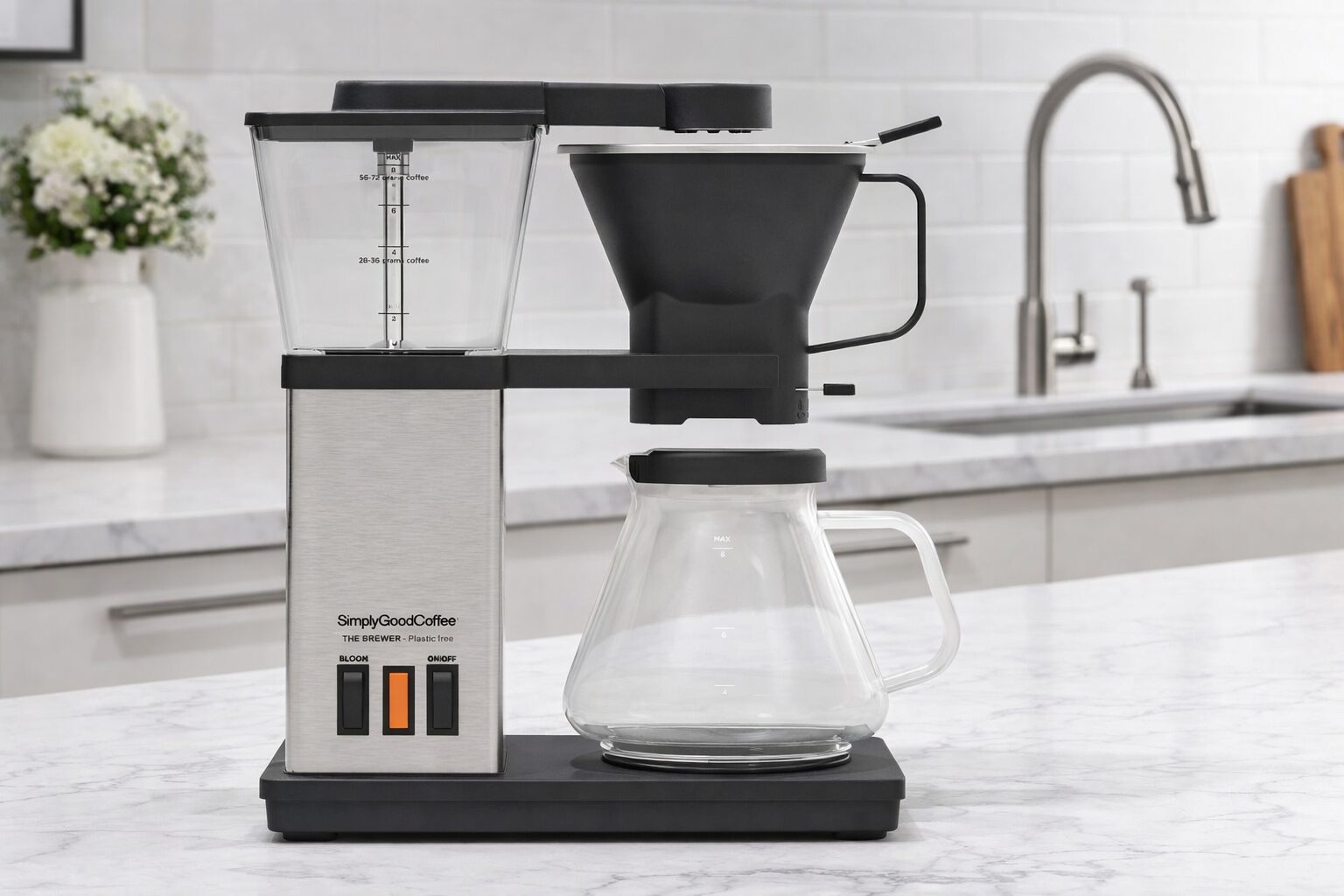
This is the one machine that clears the bar completely. Simply Good's Plastic-Free model — a distinct product in their line, not the standard Glass or Thermal brewer — removes plastic from the entire brew path. Stainless steel, borosilicate glass, and medical-grade silicone are the only materials that touch water, from reservoir to carafe.
The result in the cup is noticeably cleaner than most automatic brewers — less background noise, more of the coffee itself coming through. It holds the 195–205°F window that good extraction needs, and it's independently tested to SCA and Gold Cup standards, which most machines making material claims are not.
It is also, by a wide margin, the most expensive brewer here at around $470–$480. That's the honest trade: it's the only fully plastic-free automatic on the market, and it's priced accordingly. If that number is out of range, the percolator below does most of the same job for a tenth of the price — with a different kind of coffee at the end of it.
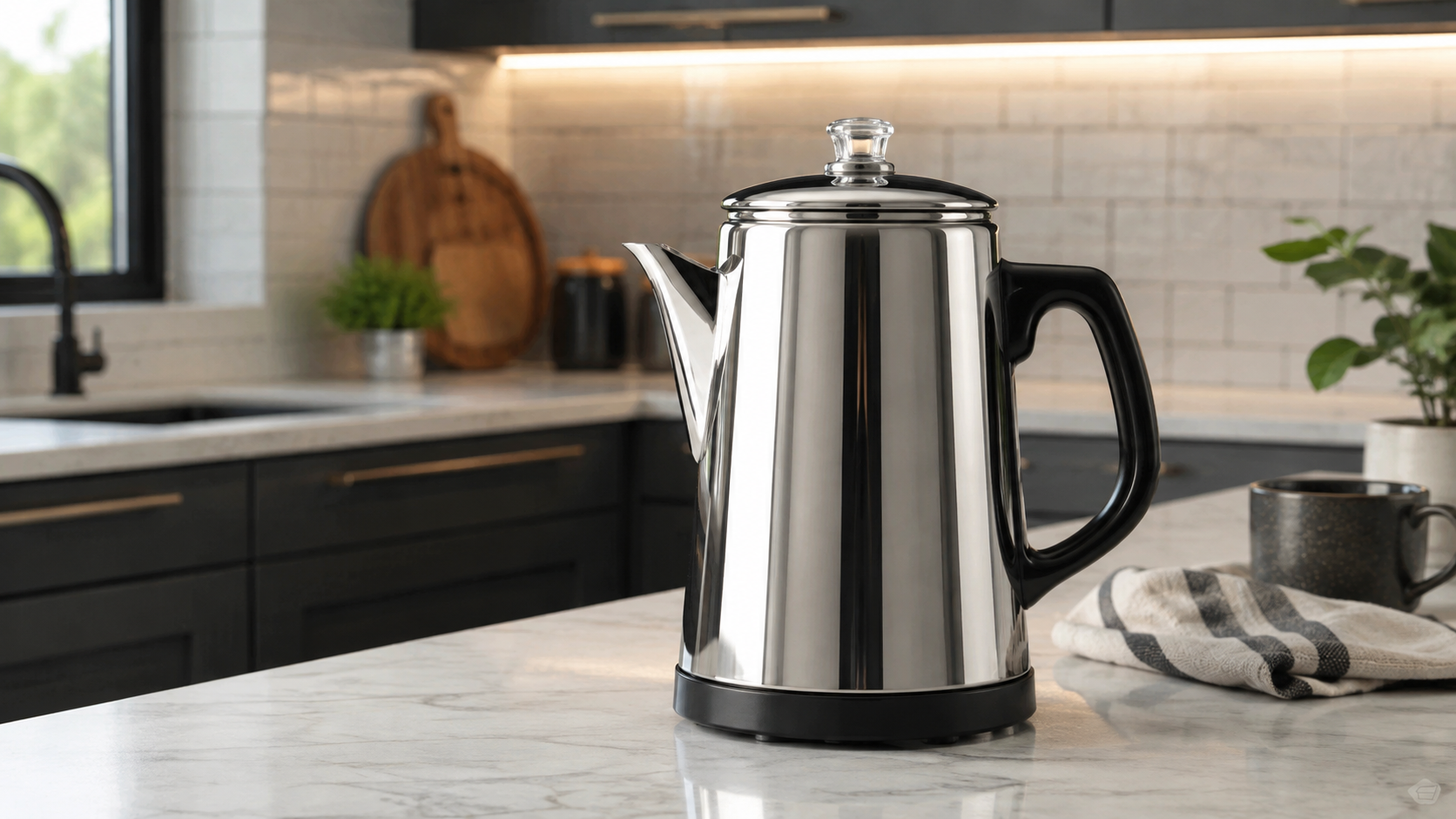
This is the category almost every plastic-free roundup forgets, and it's the one that actually answers the question for most people. A stainless steel electric percolator plugs into the wall, brews on its own, shuts off on its own, and costs around $50. The interior — the pot body, the pump stem, and the basket — is stainless steel. The plastic is confined to the handle, the lid knob, and the exterior base, none of which touch water.
Percolators went out of fashion for a reason: they cycle water through the grounds repeatedly, which pushes extraction further than a drip machine and produces a stronger, more robust cup that can tip bitter if you walk away too long. That's a real trade-off and I won't pretend otherwise. But the fix is simple — a coarser grind and pulling it off the cycle a minute early — and what you get in return is genuinely plastic-free automatic brewing for a tenth of what the Simply Good costs.
Farberware and Presto make the models most people end up with. Either is fine. The thing to actually check before buying is that the basket and pump stem are stainless rather than aluminum — it varies between models within the same brand, and aluminum is a different conversation than the one this guide is having.
Check Price on Amazon →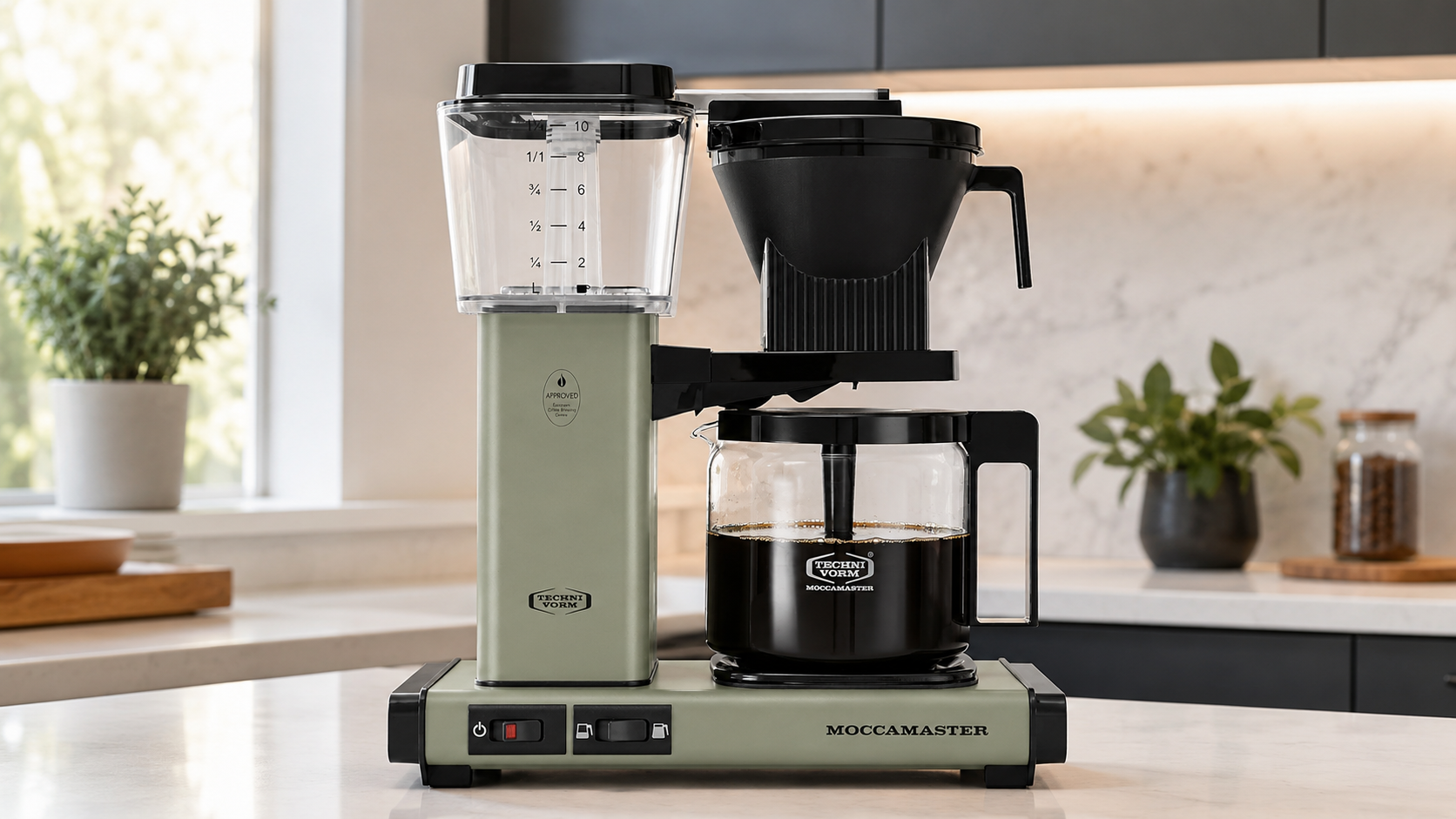
The Moccamaster turns up in almost every plastic-free coffee maker list on the internet, and it shouldn't — at least not without an asterisk. It uses SMMA, a BPA-free copolymer, in its boiler and shower arm. Both of those are squarely in the brew path.
SMMA is a genuinely better material than the commodity plastics in a $40 machine — it's more heat-stable, it doesn't yellow, and it doesn't carry BPA. If your concern is specifically BPA, the Moccamaster is a reasonable answer. If your concern is any synthetic material contacting hot water, it isn't, and no amount of the brand's reputation changes that.
I'm including it because it's the machine people are actually cross-shopping, and because leaving it off would mean you'd just find it on a less careful list that calls it plastic-free without qualification. It's an excellent brewer — I own one and reviewed it. It just isn't this.
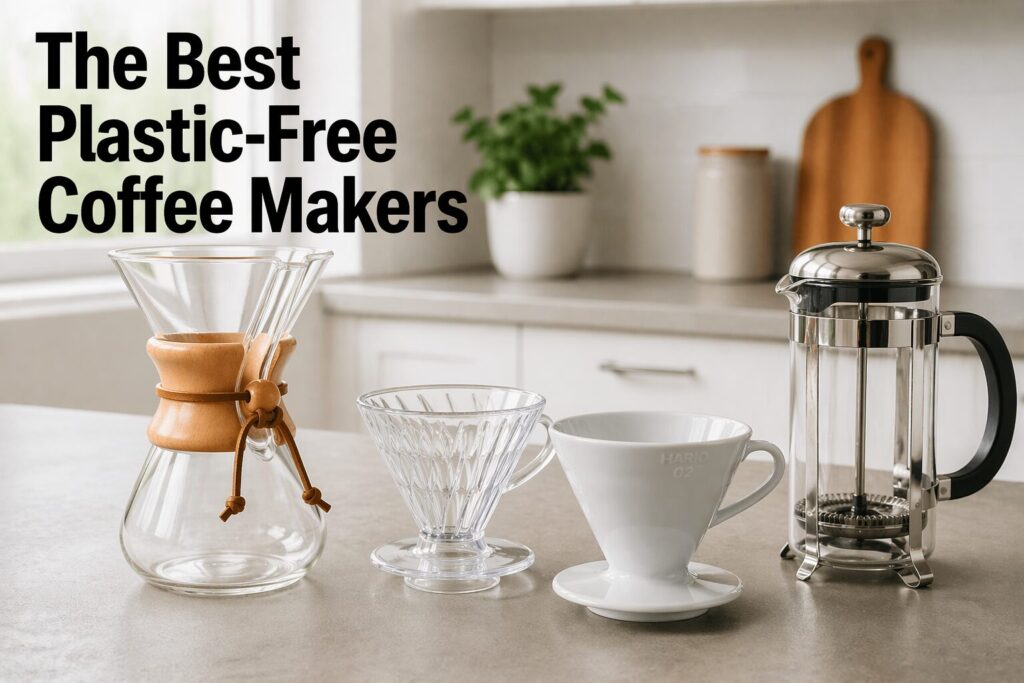
Manual brewers dominate this category for a simple reason: with no pump, no boiler, and no internal tubing, there's almost nothing left to make out of plastic. Glass, ceramic, and stainless steel do the whole job. These four are the ones worth owning, ranked by the kind of cup they produce rather than by price.
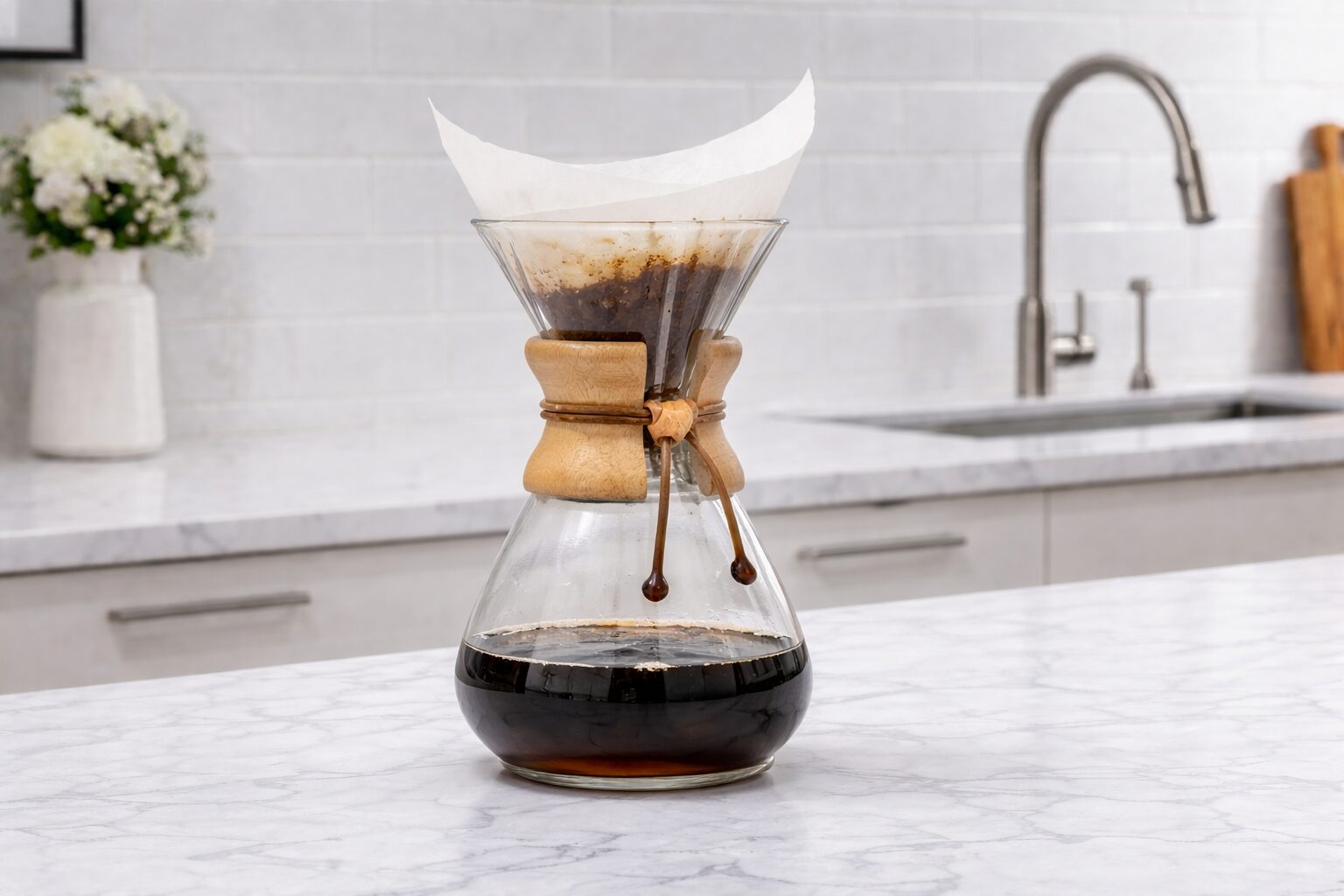
The Chemex has been making excellent coffee since 1941, and its material composition hasn't changed: borosilicate glass body, wood collar, leather tie. Nothing synthetic touches your coffee at any point in the process. It was designed to be plastic-free long before the term became a marketing angle.
The trade-off is involvement. Bloom time, pour rate, and total brew time are all on you. Done well, the Chemex produces exceptional clarity — bright, clean, well-defined flavor with a lighter body than most methods. It's the right choice if you want to taste individual origin characteristics and don't mind a five-minute morning ritual.
Check Price on Amazon →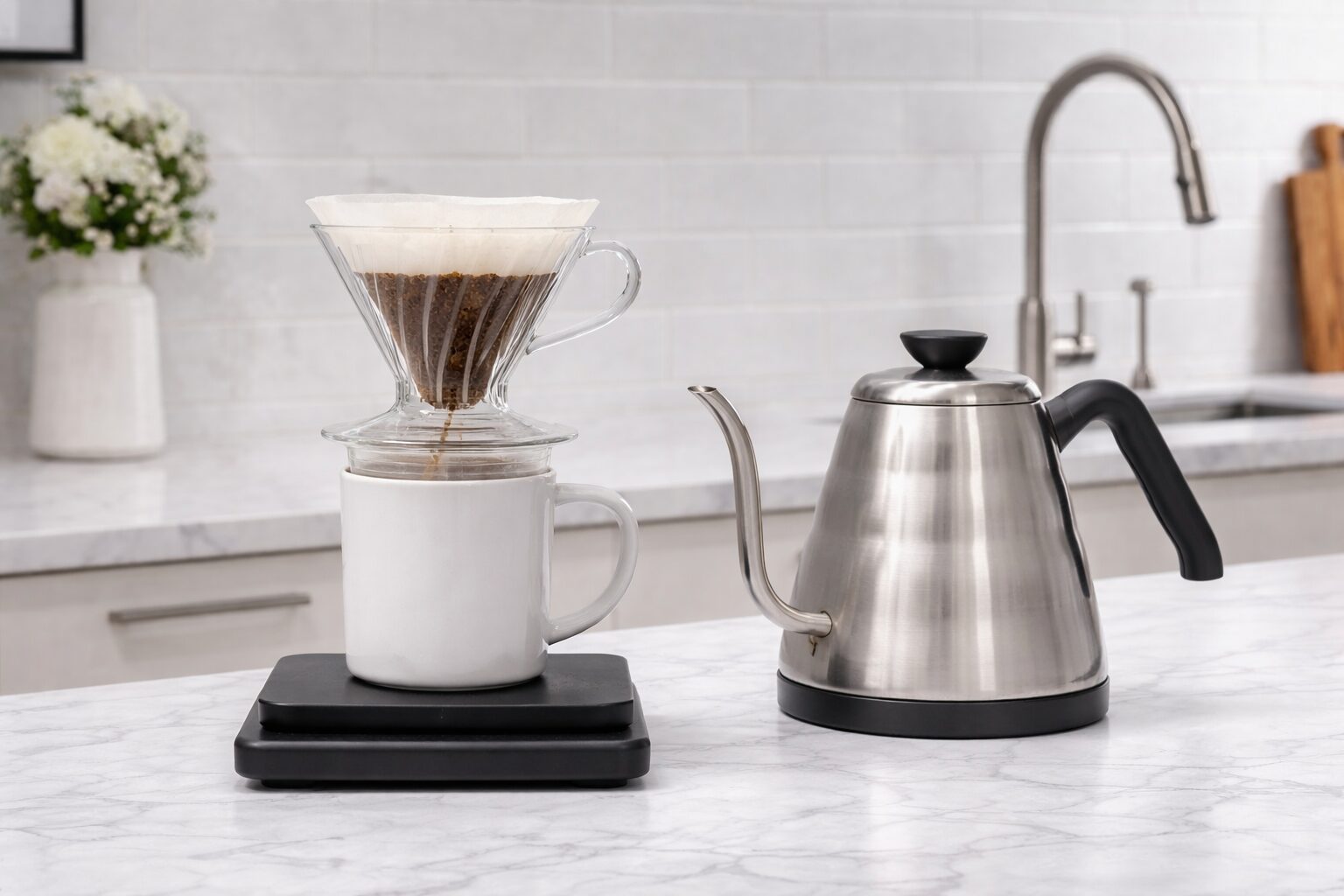
The Hario V60 glass dripper is borosilicate glass throughout. Paired with a stainless gooseneck kettle and a glass or ceramic server beneath, there's no plastic anywhere in the brew path — and the dripper alone costs around $25. It's the cheapest fully plastic-free setup on this list by a wide margin.
The V60 has a reputation for being unforgiving, and that's partly earned — the single large drainage hole means flow rate is entirely controlled by your pour, and inconsistencies show up in the cup. When you dial it in, the results are precise and repeatable. It rewards experimentation with grind size, water temperature, and pour pattern in a way the Chemex doesn't.
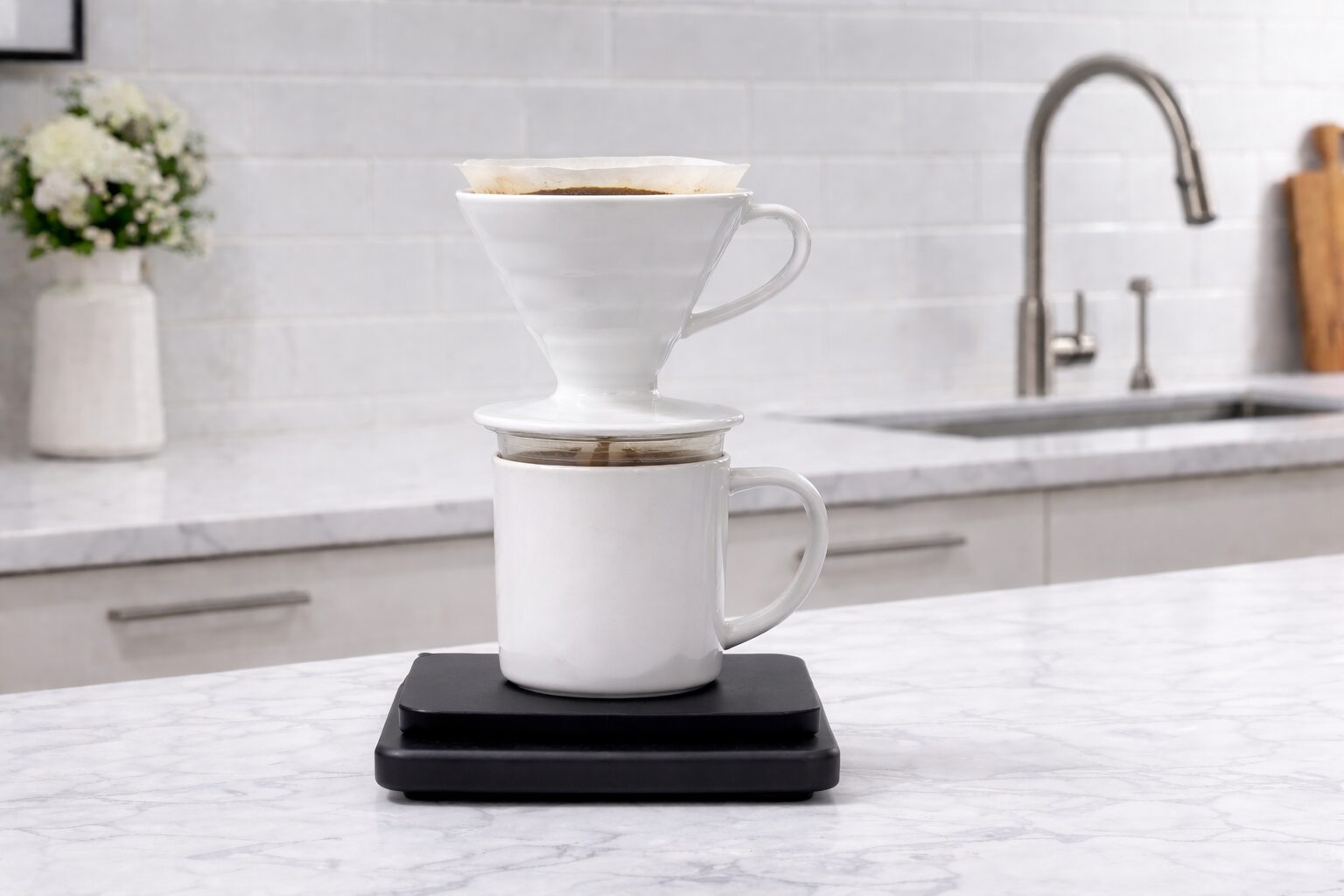
The ceramic V60 is the same dripper in a different material. Ceramic retains heat better than glass, which matters more than it might seem — a cold dripper in a cold kitchen pulls heat from your brew water and drops the extraction temperature before it even hits the grounds. The ceramic version pre-warms more slowly but holds temperature steadier once it does.
This makes it the better choice for larger volumes or for anyone brewing in a colder environment. The taste difference versus the glass version is negligible when both are properly pre-warmed; the material choice is really about consistency, not flavor.
Check Price on Amazon →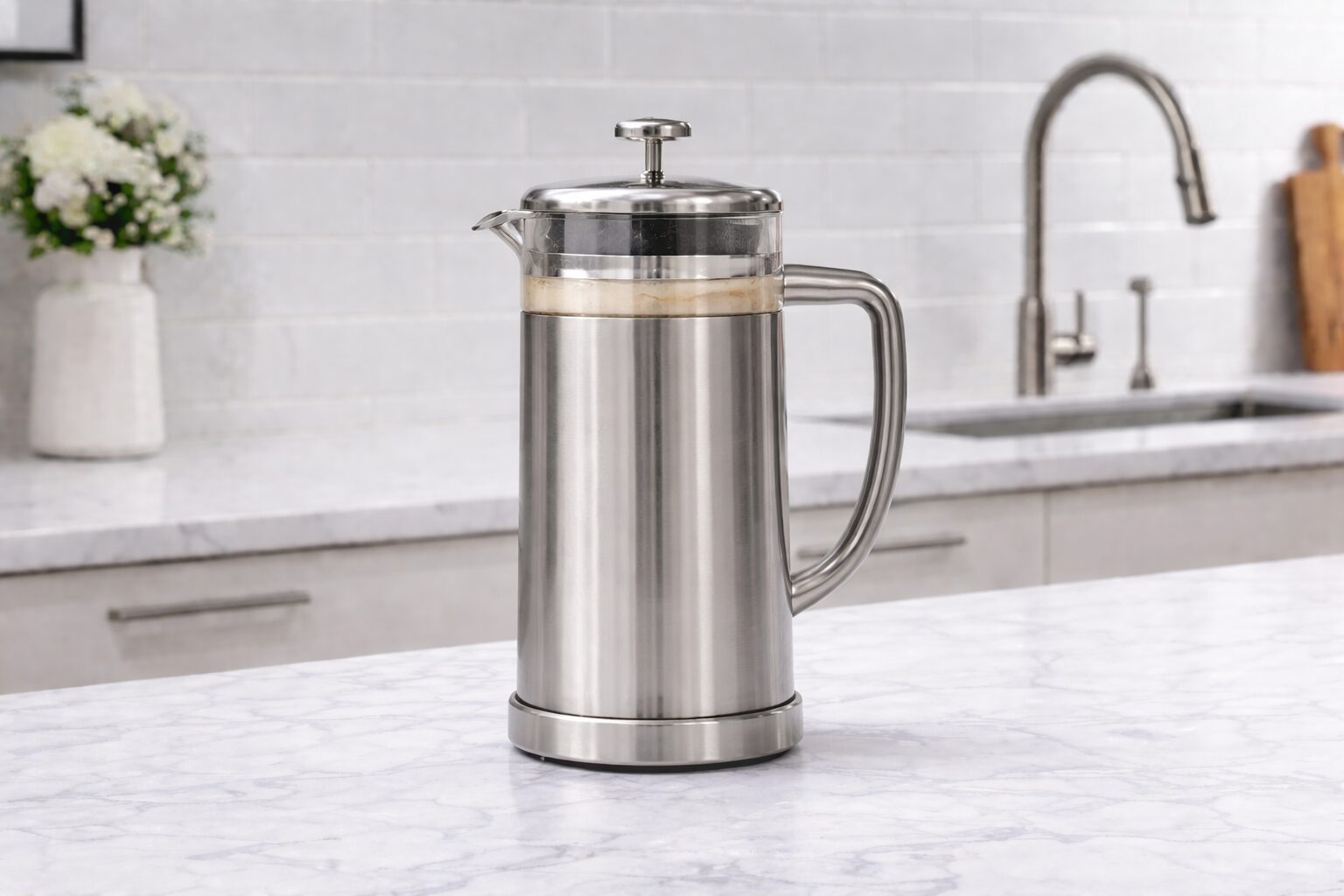
A borosilicate glass beaker with a stainless steel frame and plunger is full immersion brewing with nothing synthetic in the picture. You add grounds, add water, wait four minutes, press. The resulting cup is fuller-bodied and more textured than any pour-over — the coffee's natural oils stay in rather than being filtered out, which gives it a richness and weight that's hard to get any other way.
Grind size is the one variable worth getting right. Too fine produces sediment and over-extraction; coarser than you think you need is almost always the correct move. Beyond that, it's the most forgiving brewer on this list, and a well-built plastic-free French press costs less than $35. It also doubles as a cold brew vessel — steep overnight in the fridge and press in the morning.
Watch the lid and plunger knob on cheaper models. Plenty of "glass and stainless" French presses use a plastic lid, and the lid sits over hot coffee for the full four-minute steep.
Check Price on Amazon →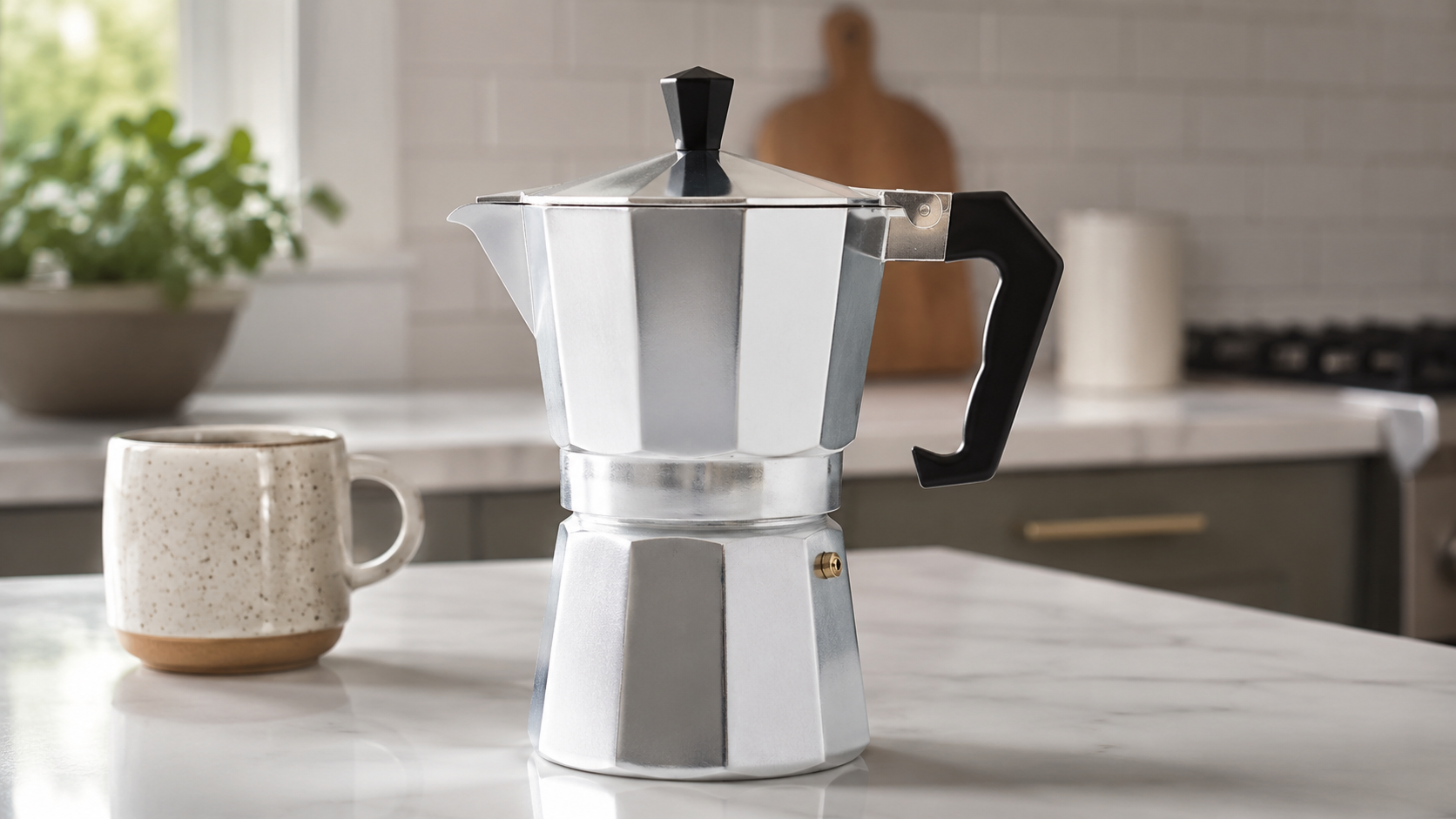
If what you actually want is a small, concentrated, espresso-style cup rather than a full pot, a stainless steel Moka pot is the plastic-free answer. Water in the bottom chamber, fine grounds in the basket, onto the stove, and pressure pushes the brew up into the top chamber. The only non-metal part in the path is a small food-safe silicone gasket.
Two things to know before buying. Most Moka pots are aluminum, not stainless — the classic Bialetti included. Aluminum isn't plastic, but it's a different material conversation, and if you're on this page you probably want stainless. Second, the handle is usually plastic or bakelite; that's outside the brew path and it's there because the alternative is burning your hand.
It's the least automatic option here and the most likely to burn your coffee if you walk away. But it's cheap, it lasts forever, and it makes something none of the other brewers on this list can. Our guide to making espresso without a machine covers the technique in detail.
Check Price on Amazon →The column that matters is the third one. "Plastic-free" is a claim; what touches your water is a fact.
| Brewer | Type | What Touches Your Water | Plastic in Brew Path? | Approx. Price |
|---|---|---|---|---|
| Simply Good — Plastic-Free | Automatic drip | Stainless, borosilicate glass, silicone | None — plastic drip tray sits outside the path | ~$470–$480 |
| Stainless Electric Percolator | Automatic electric | Stainless pot, stem and basket | None — plastic handle and base only | ~$50 |
| Technivorm Moccamaster | Automatic drip | SMMA boiler and shower arm, glass carafe | Yes — SMMA copolymer (BPA-free) | ~$359 |
| Chemex | Pour-over | Borosilicate glass only | None | ~$45 |
| Hario V60 Glass | Pour-over | Borosilicate glass only | None — but the plastic V60 looks identical | ~$25 |
| Hario V60 Ceramic | Pour-over | Ceramic only | None | ~$30 |
| Plastic-Free French Press | Immersion | Borosilicate glass, stainless filter and plunger | None — check the lid on cheaper models | ~$35 |
| Stainless Moka Pot | Stovetop | Stainless chambers, silicone gasket | None — most models are aluminum, not stainless | ~$30 |
Most people arrive at this question the other way round — not "what should I buy" but "what's in the machine I already own." Here's the short version for the brewers most likely to be on your counter.
| Machine | Plastic in the Brew Path? | Where |
|---|---|---|
| Keurig (most models) | Yes | Plastic reservoir, internal tubing, and pod holder — plus the pod itself |
| Ninja coffee makers | Yes | Plastic reservoir and brew basket |
| Mr. Coffee | Yes | Plastic reservoir, basket, and often the carafe lid |
| Cuisinart drip | Yes | Plastic reservoir and brew basket |
| Hamilton Beach | Yes | Plastic reservoir and basket |
| Breville Precision Brewer | Yes | Plastic tank and brew basket — our review |
| Technivorm Moccamaster | Partly | SMMA (BPA-free copolymer) boiler and shower arm |
| Ratio Six | Partly | Glass and stainless exterior, but plastic in the water path — our review |
| Simply Good — Plastic-Free | No | Stainless, glass and silicone only |
| Chemex / glass V60 | No | Glass throughout |
The decision starts with two questions: how involved do you want to be in brewing each morning, and what's your budget?
If the answer to the first is "not at all," you have three options and they're separated mostly by price. The Simply Good Plastic-Free is the only automatic drip machine with a genuinely plastic-free brew path, and it costs accordingly. The stainless percolator gets you automatic and plastic-free for around $50, with a stronger, more old-fashioned cup as the trade. The Moccamaster is the best-built machine of the three and makes the best drip coffee, but it isn't plastic-free and I'd rather say so than let you find out later.
If you're open to manual brewing, the choice splits by the kind of cup you prefer. The Chemex and both V60 versions produce clean, bright coffee with a lighter body — the V60 giving you more variable control, the Chemex producing something slightly more forgiving once you learn the pour. The French press goes the other direction entirely: full-bodied, textured, with the coffee's natural oils intact. The Moka pot goes somewhere else again — small, concentrated, closer to espresso. None is better; they make different cups.
If you want automatic brewing with nothing synthetic touching your water, the Simply Good Plastic-Free model is the only machine that does it, and the price reflects how alone it is in that. If that number doesn't work, a stainless electric percolator gets you most of the way there for around $50 — a different cup, but an honest one, and the option this category usually forgets to mention.
The manual brewers — Chemex, both V60 versions, a glass-and-stainless French press, a stainless Moka pot — are plastic-free by nature of their materials rather than by design intent. They ask more of you and they'll outlast any plastic machine by years. The choice between them is about what kind of cup you want, not about materials.
And if you take one thing from this guide, make it the distinction the whole page runs on: BPA-free tells you which plastic. Plastic-free tells you whether there's any. Marketing copy blurs those constantly. Follow the water, look at what it touches, and you'll get a clean answer on any machine — including the one already on your counter.

Former barista. Lifelong coffee obsessive. I started Coffee Slang to cut through the noise and share what actually matters — good recipes, honest gear takes, and a genuine love for the craft.
More About Nick →
2 Responses
It looks like the drip tray for the Simply Good is made of black plastic. How is that not in the brew path?
Fair challenge, Mike — and you’re right, the drip tray is black plastic. It deserved a proper answer, so I added a full section to the post on exactly this: “What Counts as the Brew Path (and What Doesn’t).”
Short version: the brew path is every surface water or coffee touches on its way to your cup — reservoir, boiler, tubing, shower head, brew basket, carafe. On the Plastic-Free model those are all stainless, glass, or silicone. The drip tray sits underneath the carafe and only catches spills, condensation, and the last drops after you pull the pot — coffee you’re not drinking. Same logic as the plastic power switch or the feet: it never touches what ends up in your mug.
Thanks for pushing on it. Questions like this are exactly why the section exists now.