
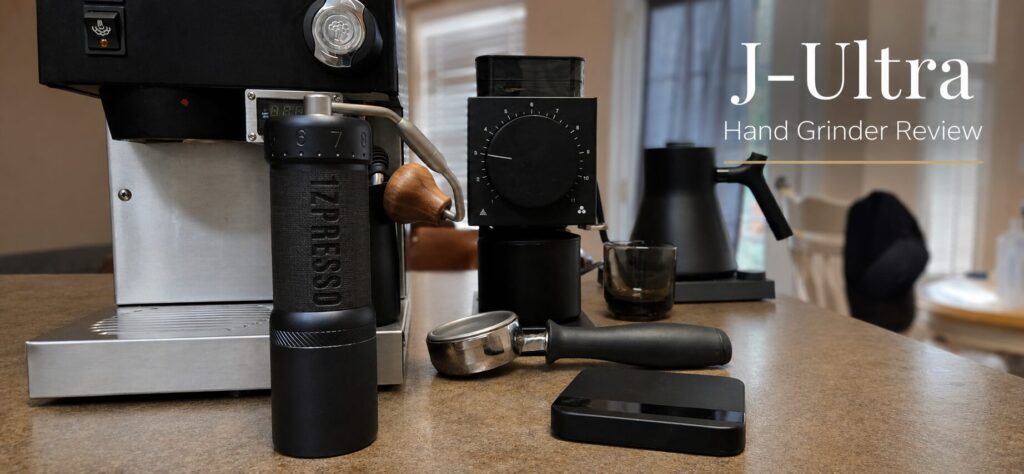
Heads up: this review contains affiliate links. As an Amazon Associate, I earn from qualifying purchases at no extra cost to you. I only recommend gear I actually use — and I bought this grinder with my own money.
A 48 mm conical-burr hand grinder built for espresso. After upgrading to it from a Baratza Sette 270, the grind consistency genuinely surprised me — the only real friction was figuring out calibration on my own.
As an Amazon Associate I earn from qualifying purchases. If you buy through this link it's at no extra cost to you — it just helps support Coffee Slang.
I'll be honest: I almost didn't buy this grinder. I'd been running a Baratza Sette 270 for a couple of years, and when it was time for a change I had my eye on something much more expensive. I wasn't ready to drop that kind of money, so I went looking for a hand grinder to bridge the gap — something to "make do" with until the end of the year.
I read a stack of reviews, went back and forth, and finally landed on the 1Zpresso J-Ultra. I was apprehensive. Going from a fast electric grinder to a manual one felt like a step backward. Then I used it for a single day, looked at the grounds, pulled a shot — and that apprehension was gone. This is my honest, long-term take after living with it.
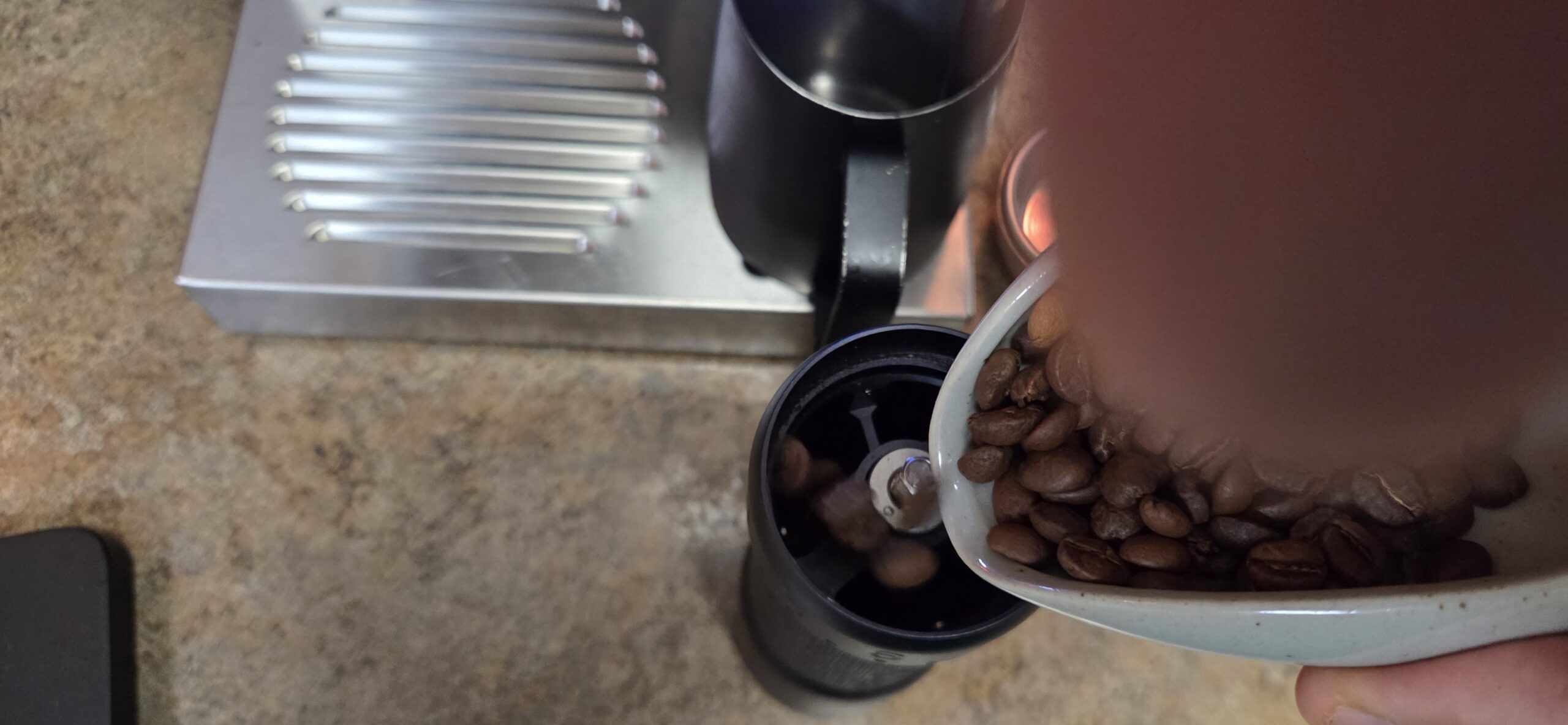
The J-Ultra is a premium manual (hand) coffee grinder from 1Zpresso, aimed first and foremost at espresso. It uses 48 mm coated conical burrs and an external, numbered adjustment dial — turn the ring, count the clicks, and you've got a grind setting you can write down and return to exactly. It's one of the grinders I cover in my guide to the best hand espresso grinders, so head there to see how it stacks up against the rest of the field.
What sets it apart from cheaper hand grinders is the precision. Each click moves the burrs roughly 8 microns, and there are about 100 clicks per full rotation across ~4.5 rotations of usable range. That's the kind of fine, repeatable control that espresso actually demands — and it's a big part of why the cup came out so clean for me.
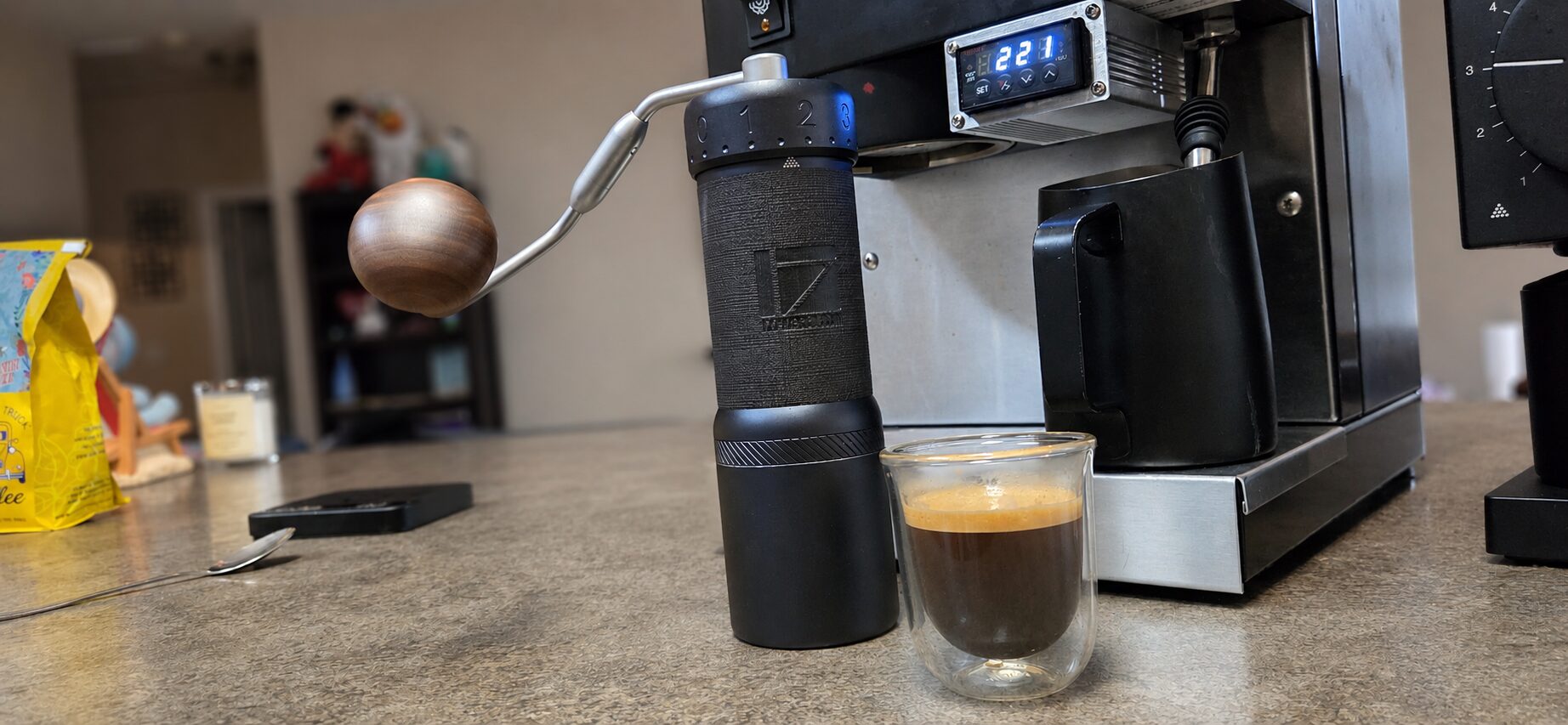
Lifting it out of the box, the first thing I noticed was the heft — this doesn't feel like a toy. Here's how the pieces break down.
48 mm coated conical burrs, tuned for espresso. They chew through a 16 g dose in around 40 seconds, which is genuinely quick for a hand grinder, and the grounds come out remarkably uniform with very few fines.
This is the headline feature. The grind dial is external and numbered: 100 clicks per rotation, each click about 8 microns, across roughly 4.5 rotations from zero. You can dial in an espresso setting, note the number, switch to pour over, and come right back to your espresso number with no guesswork.
The rounded body sits comfortably in the hand, the included silicone grip helps when you're cranking, and the handle folds down so it packs flat. A carrying case is included — this is a grinder you can actually travel with.
Magnetic, with a slight twist-off so it doesn't pop loose in a bag. It holds about 35–40 g, which covers single and double shots easily; you'll just refill for bigger pour-over batches.
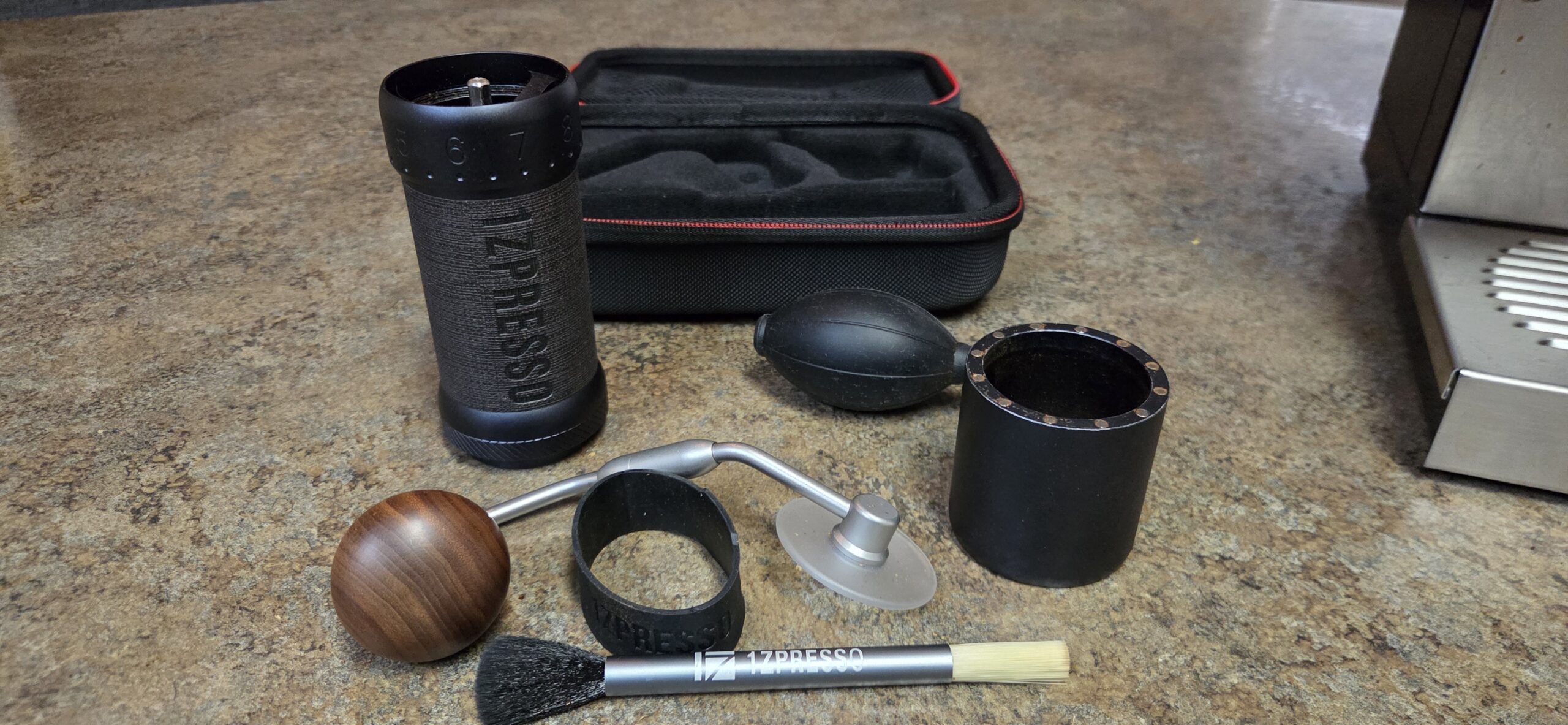
Grinder, a double-sided cleaning brush, an air blower for clearing the burr chamber, a silicone grip, and a zippered carrying case. Nothing essential is missing — you can grind your first dose the minute it arrives.
Here's my single biggest gripe, and it has nothing to do with how the grinder performs. When I got mine, I couldn't find a clear, beginner-friendly walkthrough — or a decent video — on how to calibrate (zero) it. So here's the version I wish I'd had:
That's your zero. From there, 1Zpresso's own reference puts espresso right around 100 clicks (one full rotation off zero) as a starting point — then nudge finer or coarser from there to taste. Don't stress if your zero lands within about ±10 clicks of someone else's; that's normal and depends on how firmly you tighten.
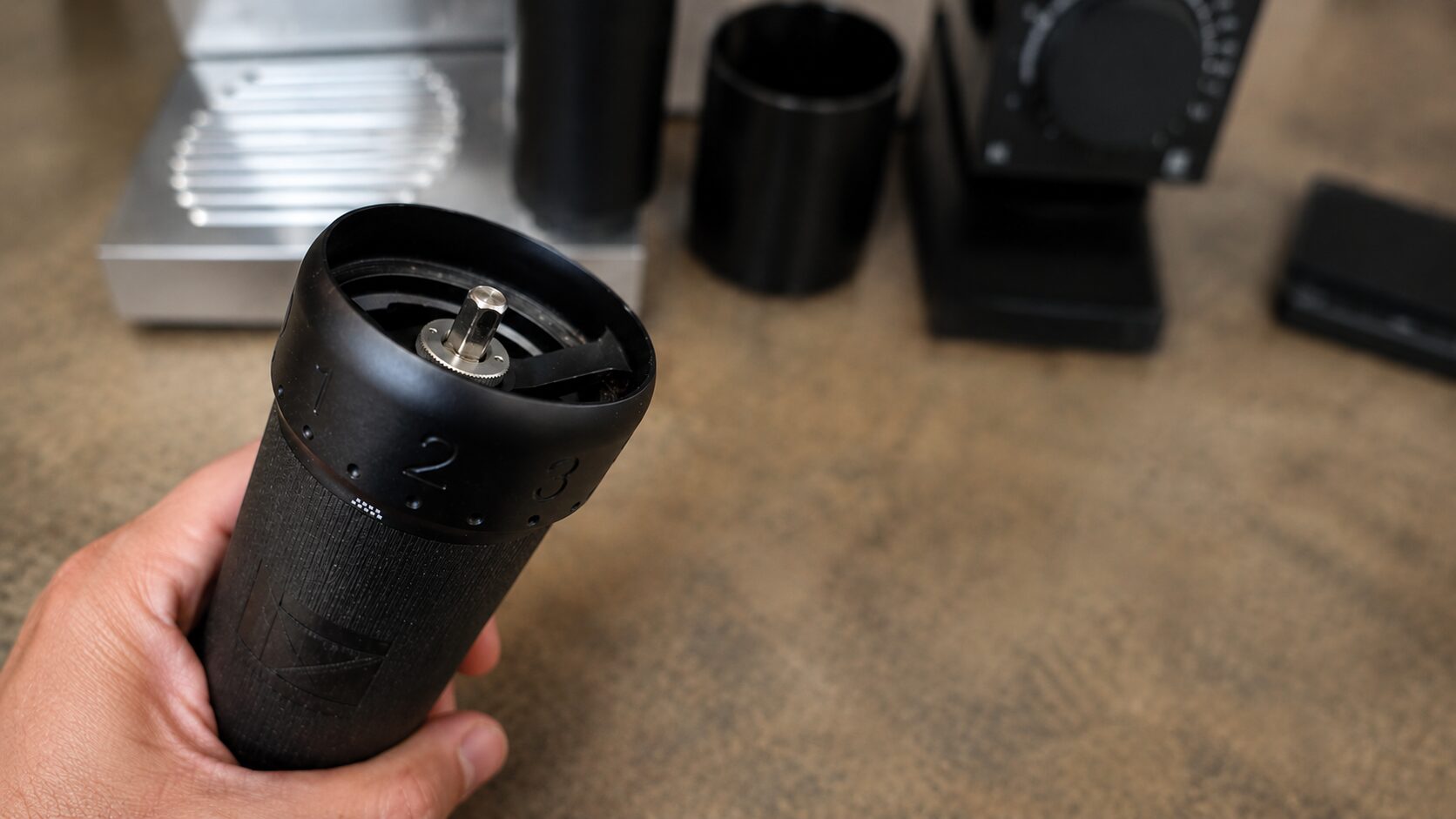
The routine is simple: weigh your dose, drop it in the hopper, fold out the handle, and grind. For 16–18 g of espresso I'm done in well under a minute, and the magnetic cup twists off cleanly for dosing into the portafilter.
Cleaning is easy — the air blower clears most of the chamber, and the brush handles the rest. Coming from an electric grinder, the one adjustment is mental: you're trading the convenience of a button for the control (and quiet) of doing it yourself. For me that trade was worth it, but it's worth knowing going in.
This is where the J-Ultra won me over. Within a day I had shots running evenly, with the kind of clean, balanced flavor I associate with much pricier setups. The low fines and uniform particle size show up directly in the cup — less channeling, more consistent extraction, fewer "why did that shot taste muddy?" mornings.
It's not espresso-only, either. Open the dial up a couple of rotations and it handles pour over and French press without complaint, though espresso is clearly where its heart is. If you want the fundamentals behind why grind quality matters this much, see how to make good coffee at home.
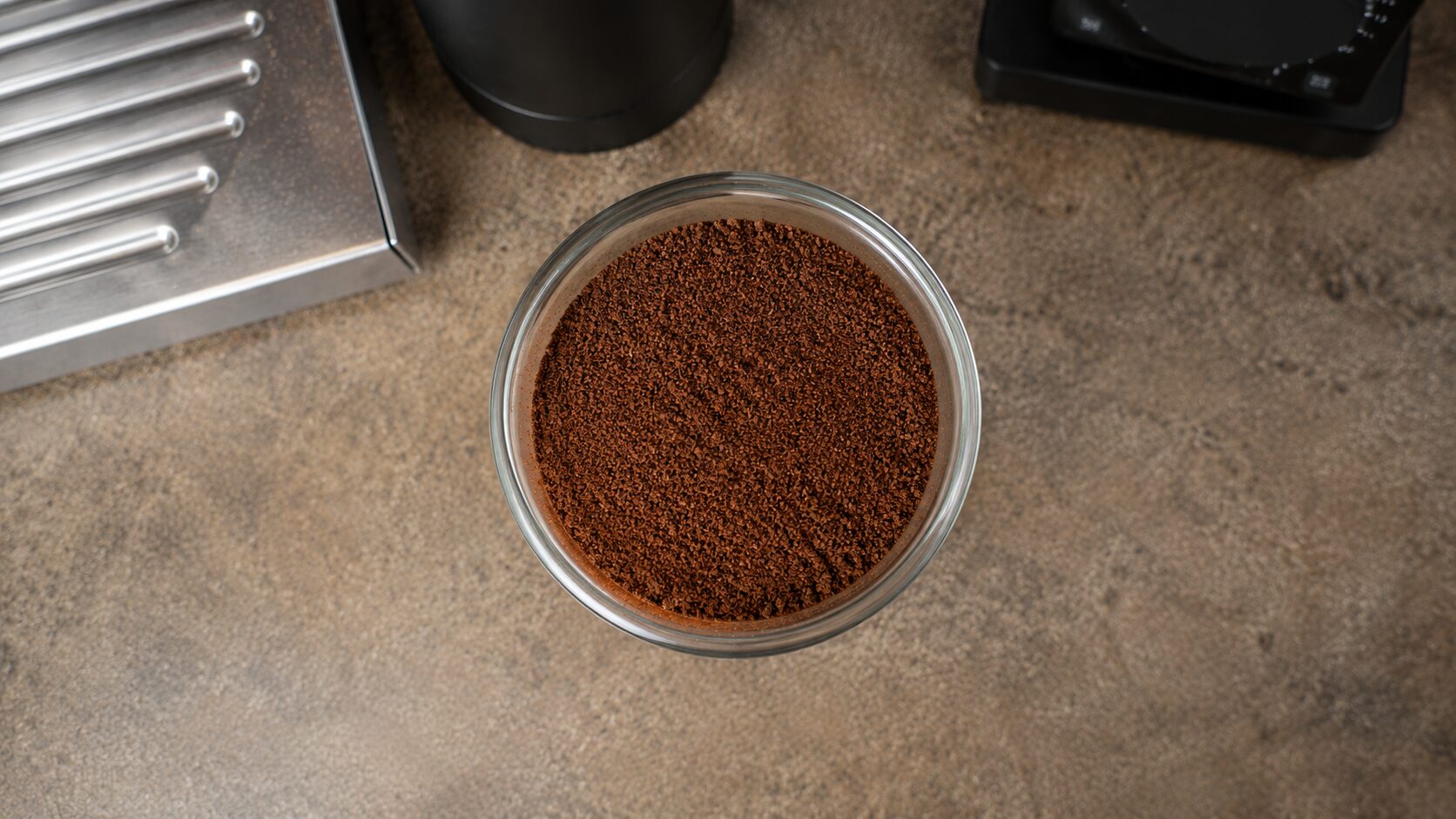
This was the comparison I cared about most, since the Sette 270 is exactly what I came from. They're different animals: the Sette is a fast electric grinder with 40 mm burrs, while the J-Ultra is a manual 48 mm grinder. The Sette wins on sheer speed and hands-off convenience — push, walk away. But for grind consistency at espresso, the J-Ultra held its own and then some, with quieter operation, no static mess, and a setting I can repeat to the click.
Did I "downgrade" by going from electric to manual? On paper, maybe. In the cup, I didn't feel like I gave anything up — which is exactly why I changed my plan (more on that in the verdict).
If you're cross-shopping, here's where the J-Ultra lands against a few options I've used or tested. (For my budget pick, see my Viesimple Gen 4 review; for a drip-focused electric, the Fellow Ode Gen 2.)
| Grinder | Type | Burrs | Best for | Adjustment |
|---|---|---|---|---|
| 1Zpresso J-Ultra | Manual | 48 mm conical | Espresso (versatile) | Numbered dial, ~8 µm/click |
| Baratza Sette 270 | Electric | 40 mm conical | Espresso, hands-off | Macro + micro steps |
| Viesimple Gen 4 | Manual | Conical | Budget espresso | Stepped |
| Fellow Ode Gen 2 | Electric | 64 mm flat | Pour over / drip | Stepped dial |
Buy it if espresso is your priority, you want professional-level grind consistency without spending four figures, and you don't mind a minute of cranking. It's also a strong pick if you travel and want one grinder that does everything well.
Skip it if you grind large batches daily, or if pushing a button matters more to you than the control and the price — in that case an electric like the Sette or the Ode makes more sense.
I bought the J-Ultra to "make do" until I upgraded at year's end. Instead, it changed the plan entirely. I'm so happy with it that I've decided to keep using it and simply keep saving toward whatever comes next — sometime next year, with no rush. When a stopgap turns into the thing you don't want to replace, that tells you most of what you need to know.
The only real knock is the thin calibration guidance, and I've tried to fix that for you above. Everything else — consistency, build, repeatability, portability — punches well above its price. If you want to see where it sits in my wider kit, here's my full coffee brewing setup and gear.
As an Amazon Associate I earn from qualifying purchases — at no extra cost to you.

Former barista. Lifelong coffee obsessive. I started Coffee Slang to cut through the noise and share what actually matters — good recipes, honest gear takes, and a genuine love for the craft.
More About Nick →