
Home » Coffee Knowledge » coffee-recipes » Café Bombón Recipe: Spain’s 1:1 Espresso & Condensed Milk Layers
 Nick Puffer
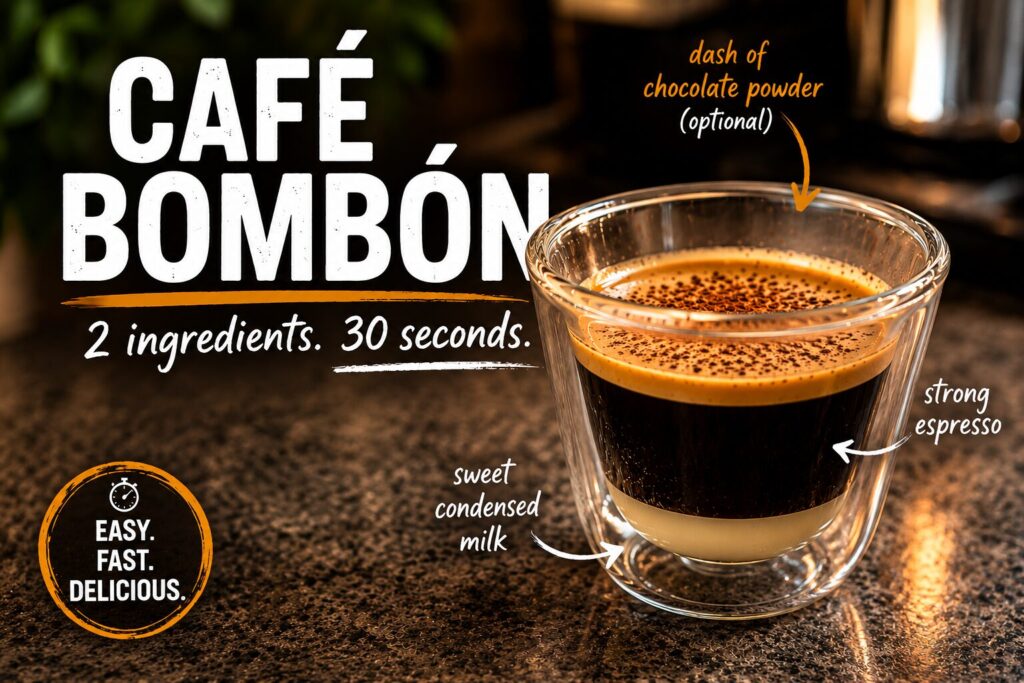
A Caffè Bombón is a Spanish espresso drink built from just two ingredients: a tight shot of espresso layered over sweetened condensed milk in a small clear glass, mixed 1:1 by weight.
Two ingredients, one small glass, five minutes. Caffè Bombón is the simplest sweet espresso drink in the catalog, and it's the one I keep recommending to people who think they need flavored syrups to enjoy a dessert-style coffee. They don't — sweetened condensed milk does all of it.
The trick is the ratio. Equal parts espresso and condensed milk, by weight. Pour it cleanly and you get a two-layer drink that looks like something from a Valencia café. Stir it, and the espresso's bitterness and the milk's caramel sweetness actually meet instead of taking turns.
The full recipe is below, plus a 30-second video of me making it, the technique notes that matter, and a quick comparison to the drinks people confuse it with.
A Caffè Bombón is espresso layered over sweetened condensed milk, served in a small clear glass, and built around a 1:1 ratio by weight. No steamed milk, no flavored syrup, no whipped cream — the condensed milk is the sweetness, the espresso is the bite, and the visual contrast is the appeal.
People mix it up with a Spanish latte all the time. Both use condensed milk, but the Spanish latte is a full café-sized drink with steamed milk and condensed milk blended together. A Bombón is short, intense, and meant to be sipped — closer in spirit to a cafecito than a latte. I get into the full distinction in the comparison table below.
This is the exact build in the video. One small glass, two ingredients, a pour technique that takes one or two tries to nail.
Most sweet coffee drinks fight themselves. Add too much syrup and the espresso disappears; pull back the syrup and the drink reads as plain bitter coffee. Caffè Bombón solves that by using sweetened condensed milk — which is roughly 40–45% sugar by weight — at a ratio close to the espresso. That much sugar can stand up to that much espresso without either side winning.
That's why the 1:1 build is the recipe, not a suggestion. A 2:1 espresso-heavy build tastes burnt. A 2:1 milk-heavy build tastes like a cold caramel sauce. The 1:1 lands in the middle on purpose. If you want to scale it up for a bigger glass, do it at the same ratio — my ratio calculator will work out the weights for you.
The other reason the ratio matters: pouring matters. Condensed milk is denser than espresso, so as long as you pour the espresso slowly (a spoon helps, but a steady hand works too), the layers separate on their own. Get the ratio wrong and the visual stops working — too much espresso and it pushes through the milk; too little and you can't even see the divide.
All three use sweetened condensed milk. That's where the similarity ends. Here's how to tell them apart on a menu or on your kitchen counter:
| Drink | Coffee | Condensed Milk | Other | Size |
|---|---|---|---|---|
| Caffè Bombón | 1 shot espresso | Equal weight (1:1) | Layered, served clear | ~80 g (small glass) |
| Spanish Latte | 1–2 shots espresso | ~30 g, blended in | Steamed milk fills the rest | ~240 g (latte size) |
| Vietnamese Cà Phê Sữa | Phin-brewed dark coffee | ~30 g, stirred in | Often iced (đá) over ice | ~240 g (tall glass) |
The short version: if it fits in a shot glass and you can see the layers, it's a Bombón. If it fills a regular latte cup with steamed milk on top, it's a Spanish latte. If it's served over ice with phin-brewed coffee, it's Vietnamese iced coffee.
The base recipe is intentionally minimal. The variations are about what you change at the margins — bigger glass, iced, a different sweet note — not about loading the drink with extras.
Add the condensed milk to a short glass, drop in two or three ice cubes, then pour the espresso slowly over the top. The condensed milk thins out faster on ice, so stir sooner than you would for the hot version. Works especially well in summer when the regular hot Bombón feels heavy.
Add half a teaspoon of unsweetened cocoa powder to the condensed milk and stir until smooth before pouring the espresso. The chocolate adds depth without making the drink sweeter — the condensed milk is already doing that job. Skip any chocolate syrup; it'll tip the balance.
A pinch of freshly ground cinnamon or cardamom on top instead of cocoa works the same way. Cardamom in particular plays well with the caramel notes in condensed milk — a trick borrowed from Middle Eastern coffee.
If you want the same flavor profile in a bigger drink, you're basically asking for a Spanish latte. Same condensed milk, same espresso base, just add 6–8 oz of steamed milk. Full method in the Spanish latte recipe.
When a Bombón goes sideways, it's almost always one of these four issues. Each has a one-line fix.
Too sweet. Drop the condensed milk to 25–30 g before changing anything else. Don't try to "balance" it by adding more espresso — you'll just end up with a bigger sweet drink.
No visible layers. The espresso was poured too fast, or it was too watery to begin with. Pour next time over the back of a spoon, slowly, and check that your espresso shot is tight (30–40 g out in 25–30 seconds, not 60 g out in 20).
Tastes flat or muddy. The espresso was under-extracted or the condensed milk was the thin, lower-fat kind. Use a full-fat sweetened condensed milk (not "condensed milk light" or evaporated milk), and check your brewing temperature if the espresso came out sour.
Espresso punched through the milk. Your pour was too aggressive, or your condensed milk wasn't cold enough. Chill the condensed milk in the fridge for 10 minutes before pouring — denser milk makes the layer hold better.
Caffè Bombón is the rare sweet coffee drink that earns its sweetness instead of dumping it in. Two ingredients, weighed at the same ratio, served in a glass small enough to drink in a few sips. No syrup, no whipped cream, no extras — and that's the point.
If you've been drinking flavored lattes and want to step toward something more grown-up but still sweet, this is the drink. Make it once with the 1:1 ratio and the pouring technique above, and you'll see why it's a fixture in Valencia cafés decades after it was invented.
Made one? Tell me how you drank it — layered first or stirred right away, and whether you stuck with 1:1 or pulled the condensed milk back. The drink rewards experimenting with the ratio more than anything else.
Bombón is one of a handful of European espresso drinks built on a single strong pour. The French answer is café au lait — equal parts strong coffee and hot milk, no espresso machine needed — and the Italian one is espresso con panna, a shot topped with whipped cream.

Former barista. Lifelong coffee obsessive. I started Coffee Slang to cut through the noise and share what actually matters — good recipes, honest gear takes, and a genuine love for the craft.
About Nick →