
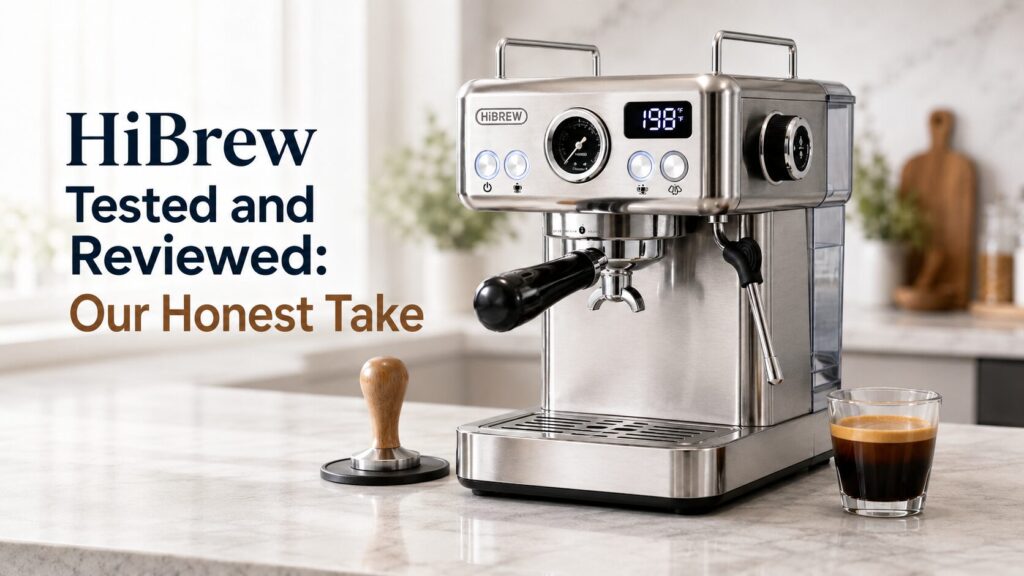
Can a $250 Espresso Machine Pull a Real Shot? I Tested the HiBREW H10A

hibrew espresso machine review
Affiliate Disclosure Coffee Slang is a participant in the Amazon Services LLC Associates Program. This post contains Amazon affiliate links, and as an Amazon Associate I earn from qualifying purchases. If you buy through a link on this page, Coffee Slang earns a small commission at no extra cost to you. I bought this machine with my own money and only review products I've personally used. No brand sponsorship was involved in this review.

HiBREW H10A — What You Need to Know

  • What it is: Semi-automatic espresso machine with a true 58mm commercial portafilter
  • Price: ~$250 on Amazon
  • Best for: Your first real espresso machine — if you already own a burr grinder
  • Standout: Ships with a single-wall, non-pressurized basket, which almost nothing else at this price does
  • Skip if: You want a proven brand with a service network, or fast back-to-back milk drinks
  • My rating: 8 / 10
  • The upgrade: A $25 tamper sized to 58.5mm fixes the one real weak point out of the box

Search "HiBREW H10A review" and look at what comes back. Page one is essentially HiBREW reviewing HiBREW. No Coffeeness. No Home Grounds. No Serious Eats. A brand selling a 58mm espresso machine on Amazon at real volume, and almost nobody independent has put one on a counter and actually pulled shots with it. That's either a warning sign or an opportunity, and you can't tell which from a spec sheet.

I've been burned from both directions. My old Breville — a well-reviewed machine from a genuinely good brand — broke four times before I gave up on it. Meanwhile the Viesimple Gen 4, a budget grinder from a brand no enthusiast forum has heard of, turned out to be one of the better values I've tested. Brand pedigree predicts less than people want it to. So when $250 bought a 58mm portafilter — the same size as the commercial machines I trained on — plus adjustable brew temperature, programmable pre-infusion, and a real pressure gauge, I wanted to know whether that spec sheet meant anything in the cup. Short answer: it does. My benchmark shots landed at 25 and 29 seconds at a clean 1:2 ratio, and the reason why is sitting in the box before you ever plug it in.

Currently around $250. My full verdict and rating are further down.


What the HiBREW H10A Is

The H10A is a semi-automatic espresso machine built around a 58mm stainless steel portafilter — commercial group-head size, at a price where nearly every competitor uses a smaller 51mm or 54mm. It runs a 20-bar pump with an analog pressure gauge on the front, uses NTC sensing with PID-style temperature management, and lets you program brew temperature, pre-infusion time, and shot volume rather than locking you into fixed presets. The body is brushed stainless steel, with plastic confined mostly to the drip tray and water reservoir.

SpecDetail
Portafilter58 mm stainless steel
Basket (stock)Single-wall, non-pressurized, tapered double, ~18 g
Pump pressure20 bar, with analog gauge
Temperature controlAdjustable, NTC/PID managed
Pre-infusionProgrammable
Shot volumeProgrammable
Steam wandManual, articulating
Three-way solenoidNo
BodyBrushed stainless steel
Warranty1 year, supported in the US
Price~$250 on Amazon
⚠️
Check the model number before you buy HiBREW's naming is genuinely confusing — there's an H10, H10A, H10B, H10 Plus, H11 and H7A, and they are not trim levels. The H10B uses a 51mm portafilter, and listing photography looks similar across several models. If the 58mm portafilter is why you're buying, confirm the listing explicitly says 58mm.

What You Need to Run It

This machine has one hard requirement, and it's worth knowing before you order.
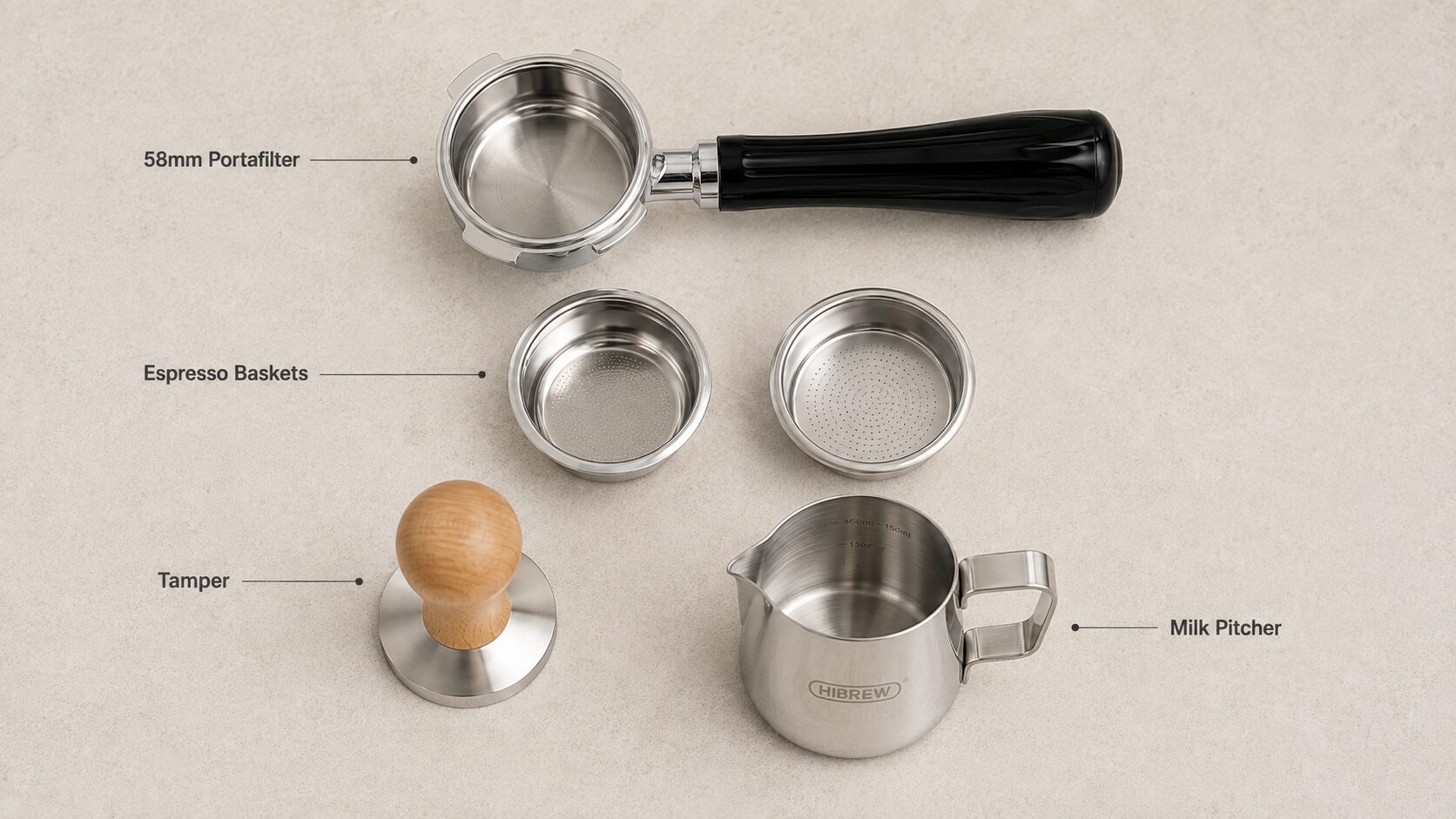
  • A burr grinder that can hit espresso fine — required. The stock basket is non-pressurized, which means water passes through your coffee and nothing else. Pre-ground coffee and blade grinders will not produce a drinkable shot here. I used the Viesimple Gen 4.
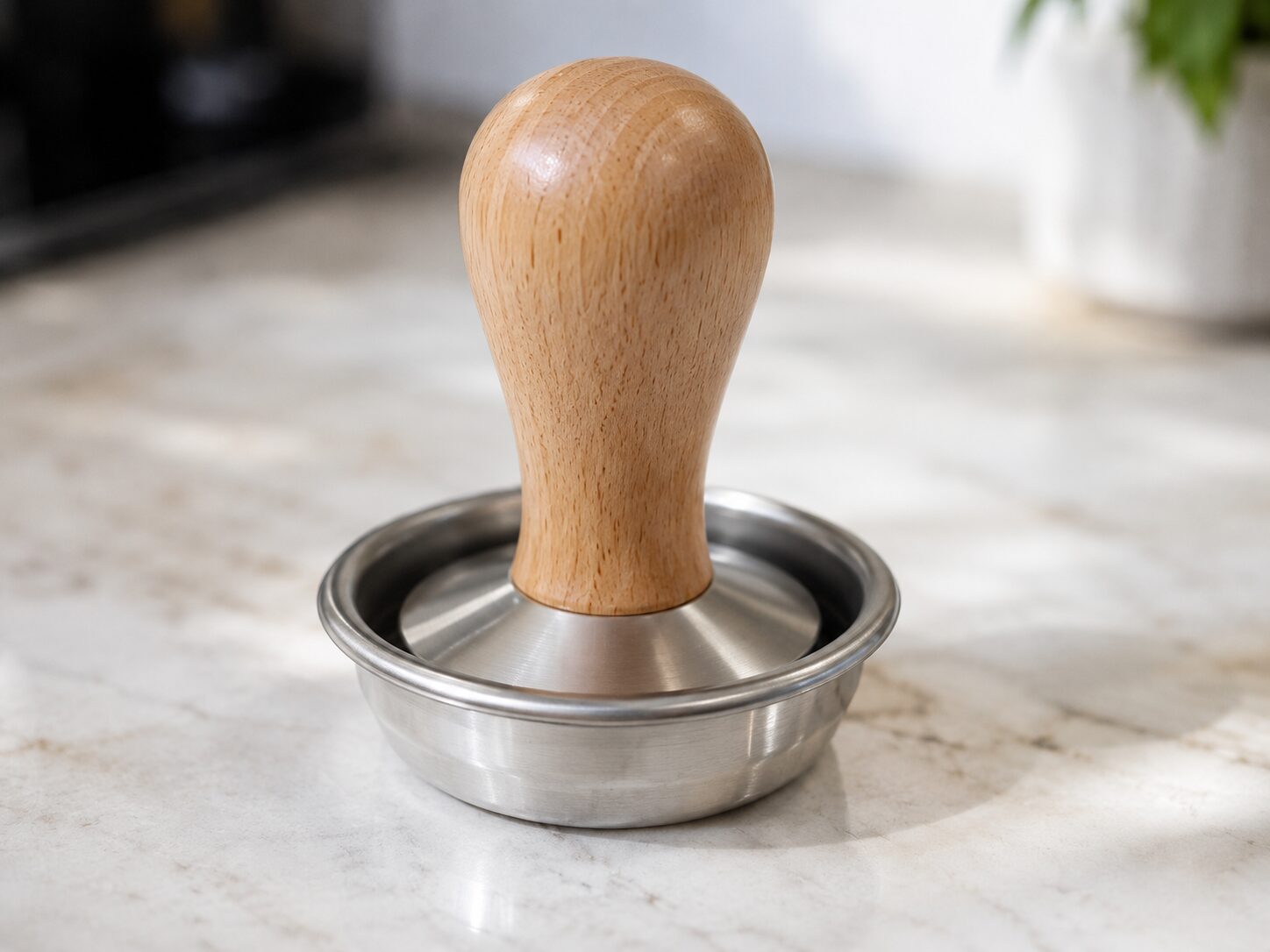
  • A tamper sized to 58.5mm — strongly recommended. The stock tamper leaves visible clearance at the basket edge. About $25, and it's the first thing I'd buy.
  • A scale that reads to 0.1g. You're weighing dose in and yield out; guessing defeats the point of a non-pressurized basket.
  • A milk pitcher if you're making lattes or cappuccinos. 12oz is the versatile size.
  • Fresh beans, medium or darker to start. Lighter roasts are harder to dial in and will expose your grinder's limits faster than the machine's.
HiBREW H10A accessories including 58mm portafilter, baskets and tamper

How It Actually Performs

Here's the part you're here for. I ran benchmark shots on the stock portafilter and stock double basket, targeting a standard 1:2 ratio in the conventional 25-to-30 second window.

Espresso shots

MeasurementShot 1Shot 2
Dose in16 g18 g
Yield out~32 g36 g
Shot time25 sec29 sec

Average: 27 seconds. Both shots landed inside the 25–30 second range, both at a clean 1:2 ratio.

The number I care about more than the average is the relationship between those two shots. Adding 2 grams of coffee — a meaningful jump in a basket rated for 18g — extended the shot by four seconds, proportionally, without the machine choking or blowing through. That's the pump behaving predictably under increased resistance. Plenty of budget machines don't: they either stall out or push straight through the puck the moment you make the bed denser, which turns dialing in into a guessing game. Predictable response to a single change is the whole game when you're learning espresso, and the H10A delivers it.

I paired it with the Viesimple Gen 4, which puts the whole setup under $400. Worth being clear about where that combination sits: the Viesimple's particle consistency is good for its price but not $200-grinder tight, and behind a non-pressurized basket you feel that more than you would otherwise. Medium and darker roasts were forgiving. If light-roast espresso is your goal, the grinder will bottleneck you well before the machine does.
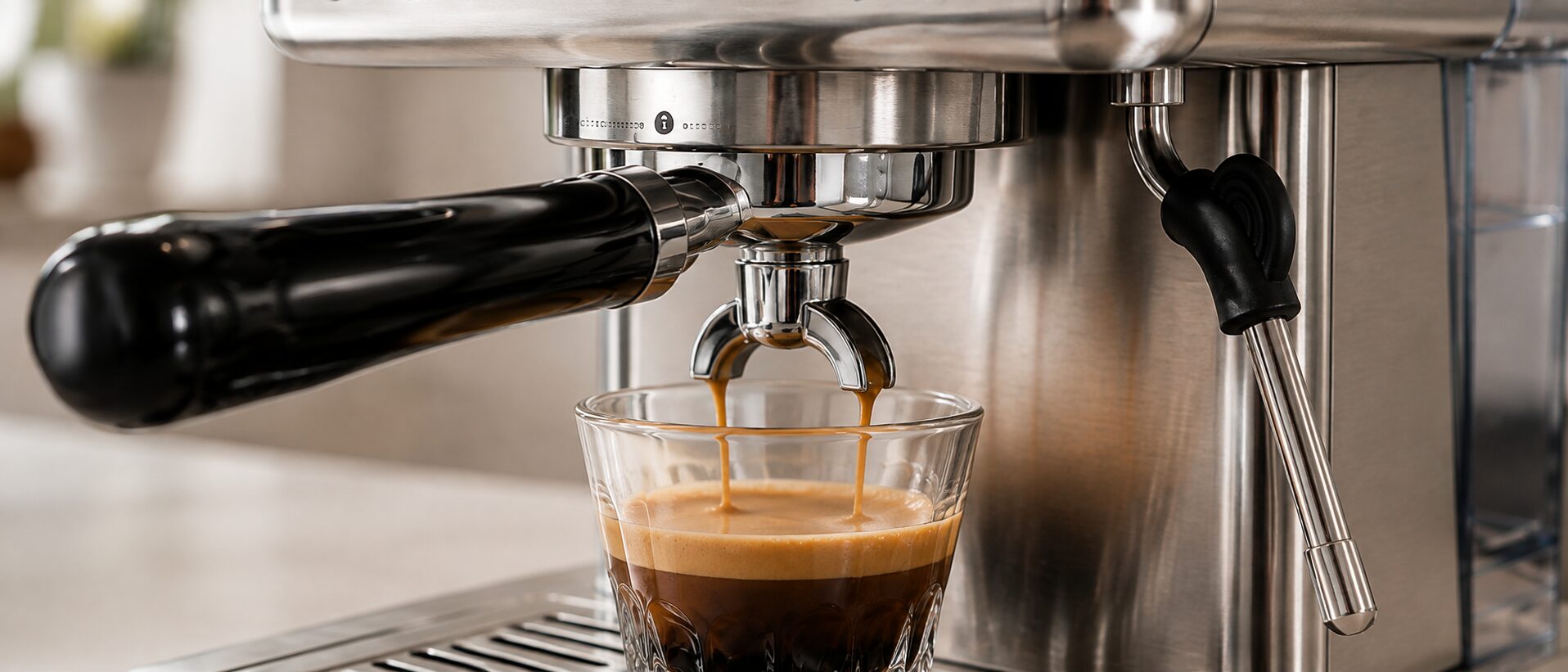
Espresso extracting from the HiBREW H10A with the pressure gauge in view

Milk steaming

Steaming 150ml (about 5 oz) of cold whole milk:

MeasurementResult
Starting temperature~40°F
Final temperature~140°F
Steam-ready after brewing~20 sec
Steaming time~44 sec
TexturePourable microfoam, good enough for basic latte art

That's a solid result. 140°F is a proper latte temperature — hot enough to feel right, well short of scalding the milk and killing its sweetness. Getting 5 oz there in about 44 seconds is workable for one or two drinks, and the wand produced actual pourable microfoam, not the stiff bubble-foam a lot of budget wands top out at. Basic latte art is on the table.

The 20-second wait between brewing and steaming is the single-boiler tax — the machine has to climb from brew temperature to steam temperature while you stand there. A Breville Bambino is ready almost instantly by comparison. In practice, 20 seconds is roughly how long it takes to grab your milk and pitcher, so it rarely felt like waiting.
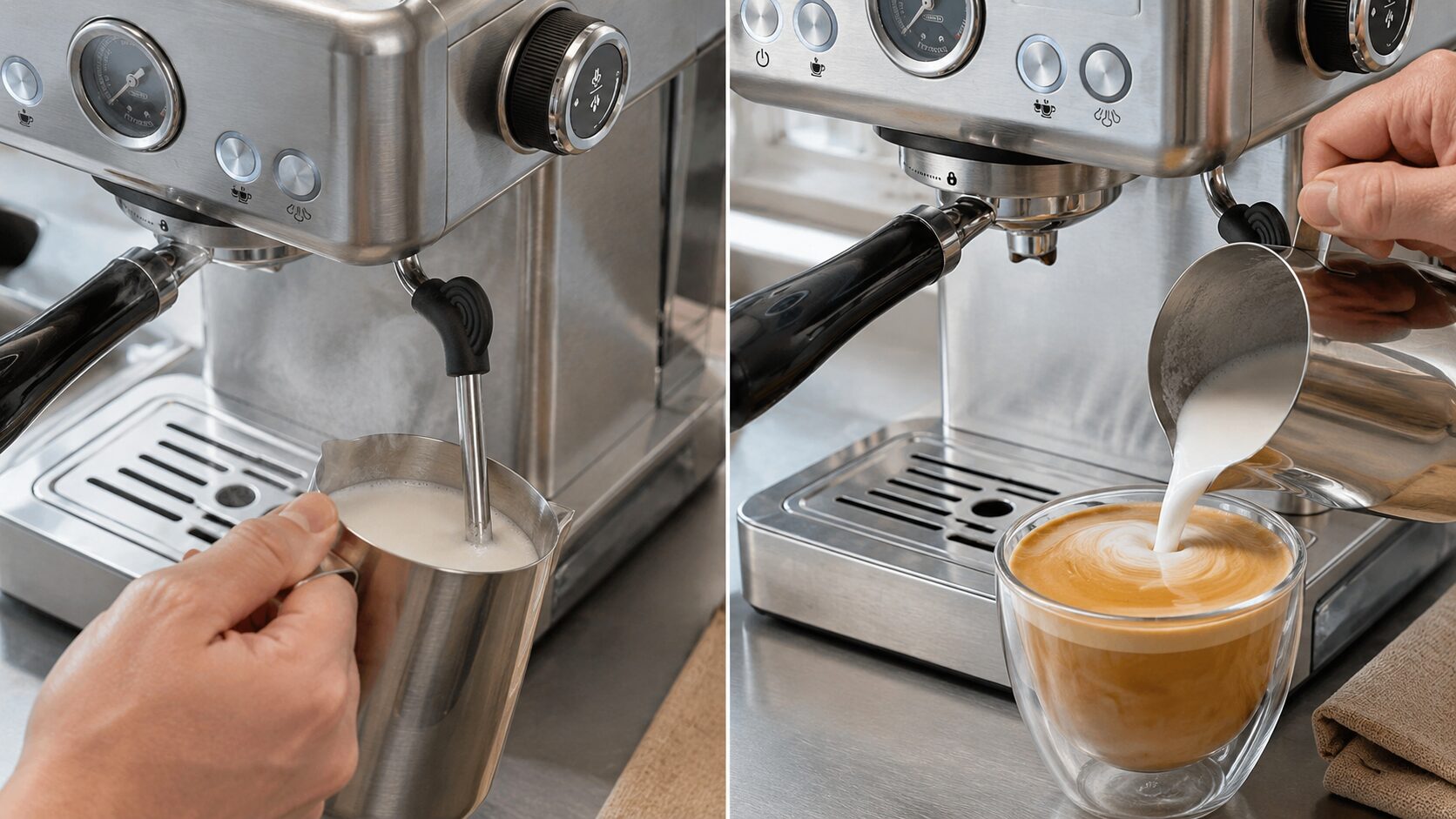
Steaming milk with the HiBREW H10A steam wand to make microfoam

The Basket Changes Everything

This is the single most important thing about the H10A, and no listing photo will tell you.

Most espresso machines under $300 ship with pressurized baskets — also called dual-wall. They have a second wall behind the filter with one tiny hole in it. Coffee doesn't extract through the grounds under real pressure; it gets forced through that pinhole, which whips air into it and produces a thick foamy layer that looks like crema. It's a trick, and a good one for the right buyer: you can use supermarket pre-ground and still get something that photographs well. But it also means your grinder is irrelevant, your tamp is irrelevant, and your dial-in is irrelevant. The basket is doing the work, not the coffee. You cannot learn espresso on a pressurized basket, because nothing you change makes much difference.

The H10A ships with a single-wall, non-pressurized basket.

Basket detailFinding
Portafilter size58 mm
Basket typeSingle-wall / non-pressurized
Basket styleTapered double
Rated capacity~18 g
Practical dose16–18 g
Internal diameter~58.5 mm
Stock tamper fitSlight clearance around the edge

That's a real espresso basket. Water passes through the coffee bed and nothing else, which means grind size, dose, distribution and tamp all matter — exactly as they should. Less forgiving, yes. But it means the shots you pull are real espresso rather than aerated coffee, and at $250, with Casabrews and Gevi and the De'Longhi Stilosa all shipping pressurized baskets at similar or lower prices, that's the H10A's genuine differentiator.

Two honest caveats. It's a tapered double, meaning the walls slope inward rather than running straight. Tapered baskets are cheaper to manufacture and slightly less precise than straight-walled baskets like an IMS or VST, which hold the puck in a more uniform column. It's a perfectly good basket — but a $25 precision basket is a real upgrade path later.
💡
Buy a 58.5mm tamper first The basket's internal diameter measures around 58.5mm, and the stock tamper leaves visible clearance at the edge. That gap is where channeling starts — water finds the under-compressed ring at the perimeter and races through it, pulling a sour, thin shot. A properly sized 58.5mm tamper costs about $25 and is the single best first upgrade. It's a common budget-machine corner-cut, and an easy fix once you know about it.
Stock tamper showing clearance gap inside the HiBREW H10A 58mm basket

The Steam Wand — My Results vs. What Owners Report

I want to handle this carefully, because it's the one area where my experience diverges from a pattern in other owners' reports.

Mine works well — the numbers are in the performance section above, and it made genuine microfoam. But across other owner reports and HiBREW's own support documentation, there's a recurring cluster of steam-side complaints:

  • Steam pressure dropping off after purging — strong pressure while the machine cools, little or none when actually texturing milk
  • The steam valve leaking or failing to shut off fully, with water weeping from the wand
  • Water routing to the portafilter head instead of the wand when steam is requested
  • Clogged steam nozzles — common enough that HiBREW publishes a dedicated troubleshooting guide
  • Brew temperature not reaching the set point, including one report of readings around 84°C against a 95°C target

Let me give that a fair framing rather than let it read as a verdict. Publishing a troubleshooting guide isn't damning on its own — plenty of good manufacturers do. Clogged nozzles in particular are usually maintenance rather than manufacturing: if you don't purge and wipe the wand after every milk drink, milk proteins bake onto the tip and block it. That happens on a $3,000 machine too.

But the steam valve reports are a different category — that's hardware, not habit. My unit works. A meaningful number of owners report units that don't. With a one-year warranty and no long-term reliability record for this brand, that's a real thing to weigh, especially if milk drinks are your main use case. If milk texturing is where you struggle generally, our guide on why your milk won't froth covers the fundamentals.


What I Liked, and What's Worth Knowing

What I liked

  • Non-pressurized single-wall basket included — rare at this price, and the reason this machine can actually make espresso
  • True 58mm commercial portafilter — your accessories carry forward when you upgrade
  • Shots at 25 and 29 seconds at a clean 1:2 ratio, with predictable, proportional response to dose changes
  • Steam wand produced real pourable microfoam at a proper 140°F
  • Programmable brew temperature, pre-infusion and shot volume — genuine control, not preset theater
  • Analog pressure gauge gives useful feedback while you're learning what changes what
  • Mostly stainless construction, with plastic confined to the tray and reservoir

Worth knowing

  • Stock tamper leaves clearance against the ~58.5mm basket — budget ~$25 for a properly sized one
  • No three-way solenoid — wet pucks and messier cleanup (see below)
  • Tapered basket rather than a precision straight-walled one — fine, but an upgrade path exists
  • ~20-second wait between brewing and steaming — the single-boiler tax
  • Steam valve failures are the most consistent complaint from other owners — mine is fine, but the pattern is there
  • One-year warranty, against two years from several competitors
  • No independent long-term testing exists for this brand; there's no track record to check
  • Requires a real burr grinder. Pre-ground coffee will not work with this basket
⚠️
Wait before you unlock the portafilter The H10A has no three-way solenoid valve — the part that vents group-head pressure and dries the puck on pricier machines. Your puck will come out wet and sludgy rather than as a knockable disc. That's normal, not a fault. But pull the portafilter immediately after the shot and residual pressure gives you a "sneeze" — a spray of wet grounds across the counter. Give it a few seconds.

My full verdict, rating and who should buy it are in the card below.

☕ The Former-Barista Verdict
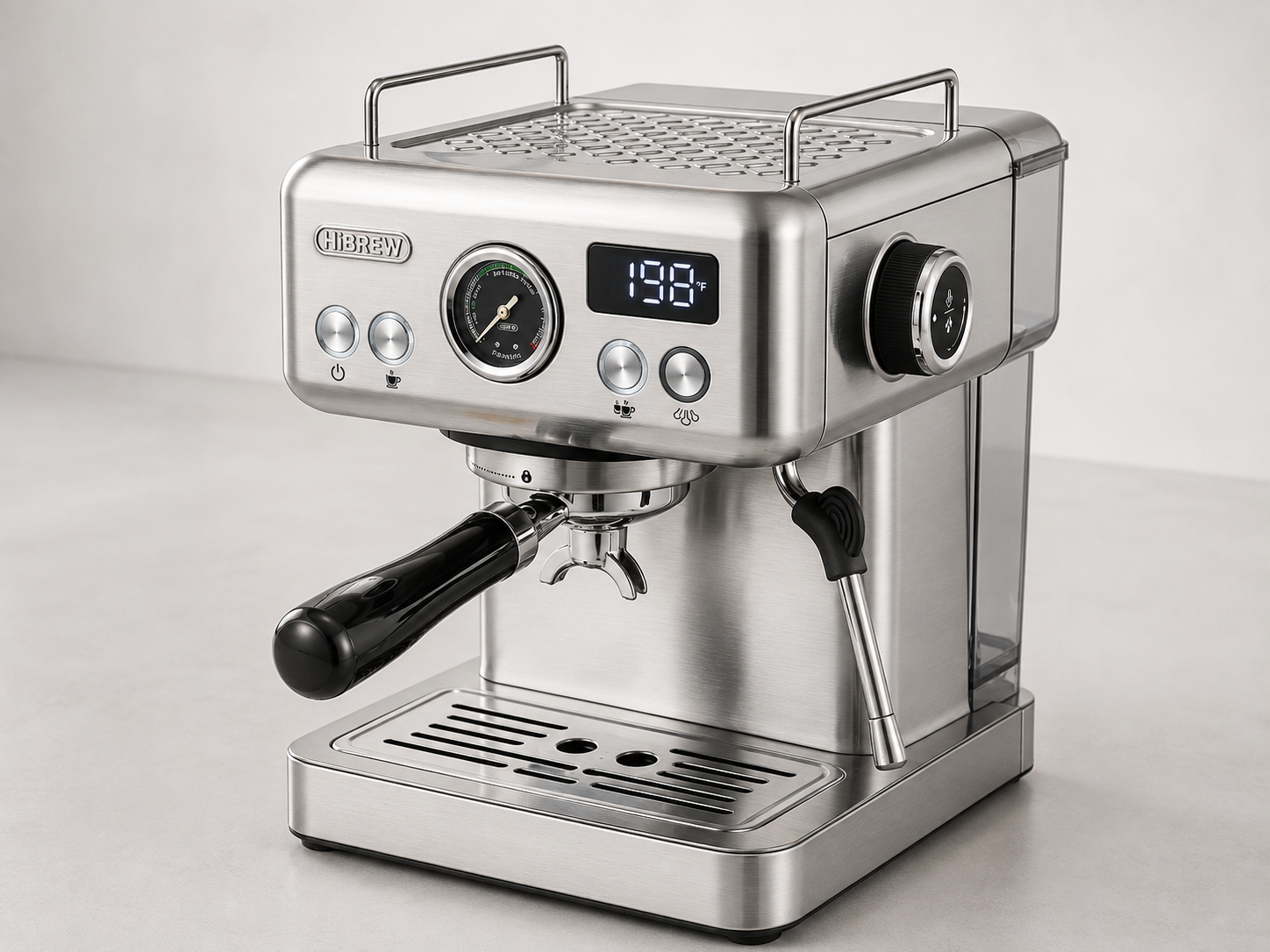
HiBREW H10A Espresso Machine

HiBREW H10A espresso machine, tested and reviewed by Coffee Slang
8/ 10 Impressive hardware and a real basket for the price, with honest budget compromises and an unproven brand behind it.
Price~$250 on Amazon
Best forYour first real espresso machine, if you own a burr grinder
StandoutNon-pressurized 58mm basket, stock
Weak pointUndersized stock tamper; no three-way solenoid
My shots25 & 29 sec at a 1:2 ratio
Milk5 oz to 140°F in ~44 sec, pourable microfoam

The HiBREW H10A is the most machine I've used at $250, and the non-pressurized 58mm basket is why. It ships ready to make real espresso rather than the aerated imitation most machines in this bracket produce, my shots landed where they should, and the steam wand made pourable microfoam at a proper latte temperature. The programmability and pressure gauge give a beginner something to actually learn on.

The corners are cut where you'd expect: an undersized stock tamper, no three-way solenoid, a tapered basket, a one-year warranty, and a brand with no reliability track record anyone can verify. The steam valve complaints from other owners are what I'd weigh hardest — mine works, but that's one unit.

If you want to learn espresso properly on a budget and you already have a burr grinder, this is a lot of machine for the money. If you want something proven that just works, spend the extra $50 on a Bambino and don't look back.

I bought this machine with my own money. Coffee Slang earns a small commission if you buy through this link, at no extra cost to you.

How It Compares to the Machines You're Cross-Shopping

Now that you know what the H10A actually does, here's where it lands against the machines most people weigh against it. The row that matters most is the stock basket.

HiBREW H10ABreville BambinoCasabrews CM5418De'Longhi Stilosa
Price~$250~$300~$150~$100
Portafilter58 mm54 mm51 mm51 mm
Stock basketNon-pressurizedDual wallPressurizedPressurized
Adjustable tempYesNoNoNo
Pre-infusion controlYesFixedNoNo
Pressure gaugeYesNoNoNo
Steam-ready time~20 sec~3 sec~30 sec~40 sec
Brand track recordNone establishedExtensiveModerateExtensive
Warranty1 year2 years1 year1 year

Against the Breville Bambino. The Bambino is the safe choice and I won't pretend otherwise — near-instant heat-up, an excellent steam wand for the price, a two-year warranty, and a service network that actually exists. But it's a 54mm machine that ships with dual-wall baskets, with no temperature adjustment and no pressure gauge. If you want to learn espresso, the H10A hands you more to work with and a real basket out of the box. If you want reliability and speed and don't care about tinkering, the Bambino earns its extra $50.

Against the Casabrews CM5418. The Casabrews is $100 cheaper and far better known, but it's a 51mm pressurized-basket machine. It's engineered to make espresso easy, not to make espresso good. That's a legitimate goal for plenty of buyers — it's just a different machine for a different person, and no amount of grinder upgrading will change what that basket does.

Against the De'Longhi Stilosa. Not really a comparison. The Stilosa is a fine $100 entry point to find out whether you enjoy the ritual. It isn't trying to do what the H10A does.

For the full field at every price point, our best affordable espresso machines guide covers $65 through $700.


Which HiBREW Should You Actually Buy?

HiBREW's model naming is the most confusing thing about the brand, and buying the wrong one is a genuine risk — the listings look nearly identical. Here's what actually separates them.

  • H10A — the machine in this review. 58mm portafilter, non-pressurized stock basket, programmable temperature and pre-infusion, pressure gauge. ~$250. This is the one to buy if you want to learn real espresso.
  • H10B51mm portafilter, roughly half the footprint, cheaper. A reasonable pick if counter space is your binding constraint, but you lose the commercial portafilter size and the accessory compatibility that comes with it.
  • H10 / H10 Plus — earlier and intermediate variants in the same family. Specs vary by listing; check the portafilter size line by line rather than assuming.
  • H11 — slim-profile machine that also accepts ESE pods. Convenience-oriented rather than craft-oriented.
  • H7A — the flagship: dual boiler with a built-in grinder and a touchscreen. Considerably more money, and a different class of purchase.

Troubleshooting the H10A

Most of the problems people hit with this machine fall into four buckets, and three of them are fixable at home.

The steam wand won't build pressure. The most common cause is a clogged nozzle from milk residue. Purge and wipe the wand after every drink, and clear the tip with a pin if it's blocked. If purging doesn't restore pressure, or the wand leaks water when it's shut off, that points to a steam valve fault — that's a warranty claim, not a home fix, and it's the most consistently reported hardware issue on this machine.

Your shots run too fast and taste sour. With a non-pressurized basket this is almost always grind size or the tamper gap. Go finer first. If the shot is still fast, check whether your tamper is leaving a ring of loose coffee at the basket edge — water races through that gap. A 58.5mm tamper solves it.

The puck comes out wet and sludgy. Normal. The H10A has no three-way solenoid to vent group pressure after the shot, so water stays in the puck. Rinse or scoop rather than knocking out, and wait a few seconds before unlocking the portafilter or you'll get sprayed.

Brew temperature isn't hitting your set point. Run a blank shot through the empty portafilter first to bring the group head up to temperature — a cold group will pull several degrees off your first shot on any single-boiler machine. If it's still well short after warming up, that's a sensor issue worth raising under warranty.


Frequently Asked Questions

Does the HiBREW H10A come with a pressurized basket?
No, and this is the machine's biggest selling point. The H10A ships with a single-wall, non-pressurized tapered double basket rated around 18g. Most machines at this price ship dual-wall pressurized baskets that create artificial crema and mask what your grinder is doing. The H10A's basket makes real espresso, which also means it requires a proper burr grinder to work.
Is HiBREW a good brand?
HiBREW is an Amazon-native brand with a real product line — semi-automatic machines, grinders and portable espresso makers — but almost no independent review coverage in the US and no long-term reliability record you can verify. The hardware is legitimately good for the money. Durability is the open question. Buy it because the machine is good, not because the brand is proven.
HiBREW H10A vs Breville Bambino — which should I buy?
The Bambino heats almost instantly, has a better steam wand, and comes with a two-year warranty and a real service network. The H10A gives you a 58mm portafilter, a non-pressurized basket out of the box, adjustable brew temperature, programmable pre-infusion and a pressure gauge for about $50 less. Choose the Bambino for reliability and speed; choose the H10A for control, a real basket and accessory compatibility.
Do I need a special grinder for the HiBREW H10A?
Yes, and this matters more than the machine itself. The non-pressurized basket means water passes only through your coffee, so grind size and consistency directly determine whether the shot works. A blade grinder or pre-ground coffee will not produce drinkable espresso here. I paired mine with the Viesimple Gen 4, which keeps the whole setup under $400.
Can the HiBREW H10A make latte art?
Yes, basic latte art is achievable. My wand took 150ml of cold milk from about 40°F to 140°F in roughly 44 seconds and produced pourable microfoam rather than stiff foam. Note there is a roughly 20 second wait between finishing your shot and the machine reaching steam temperature, because it's a single boiler.
Why is my espresso puck wet after the shot?
Because the H10A doesn't have a three-way solenoid valve, which is the part that vents group-head pressure and dries the puck on more expensive machines. It's a normal omission at this price, not a fault. Wait a few seconds before unlocking the portafilter or residual pressure will spray wet grounds across your counter.

Bottom Line

The HiBREW H10A is a strange product to review, because on paper it shouldn't be this good at $250 — and because almost nobody has bothered to check. What I found is a machine that ships with a real basket, pulls shots that land where they should, textures milk properly, and gives a beginner genuine variables to learn on. The compromises are the ones you'd expect at this price and none of them are dealbreakers, though the stock tamper should be your first $25.

What I can't tell you yet is whether it lasts. That's the honest gap in every review of this brand, mine included, and it's the reason I'd point anyone who values a service network toward a Bambino instead. I'll update this post after six months of daily use. In the meantime, if you're building a budget setup around it, the grinder is where your next dollar should go — start with the Viesimple Gen 4 review for the budget option I paired with this machine, or our best hand espresso grinders guide if you'd rather grind by hand.

Nick Puffer, former barista and founder of Coffee Slang

Nick Puffer

Former Barista · Founder

I bought this machine with my own money and pulled shots on it daily. Every number in this review came off my own scale and thermometer — no brand sponsorship, no press sample, no freebies.

More About Nick →

Leave a Reply

Your email address will not be published. Required fields are marked *