

I've reviewed the $7 handheld wand everyone recommends, I've written a whole guide to frothers, and I spent years texturing milk on a commercial steam wand before any of that. So when people ask me whether a $40 automatic frother is worth it over the cheap wand, I wanted a real answer rather than a guess.
The Instant Milk Frother is the one that keeps turning up — it's from the Instant Pot people, it's usually around $40, and it does four things instead of one. I bought one and have been using it for the past few weeks, mostly for morning lattes and iced drinks.
The short answer: it's a genuinely different tool from a handheld wand, and the cold foam mode is the reason to own one. It also won't get you anywhere near latte art, and it has one design flaw that will make a mess of your counter until you learn to work around it. Here's the full picture.
Usually around $40. My full verdict and rating are further down.
An automatic milk frother and warmer with a 10oz jug, a magnetic whisk, and a two-button interface. You pour milk in, press a button, and walk away — it heats and whisks on its own and shuts off when it's done. No holding, no timing, no judgment calls.
The "4-in-1" is four programs rather than four appliances: cold foam, light warm foam, thick warm foam, and warm milk with no foam at all. That last one sounds trivial until you have kids or drink hot chocolate.
| Spec | Detail |
|---|---|
| Capacity | 10 oz / 295 ml jug — less when frothing, since foam needs room to climb |
| Programs | 4 — cold foam, light warm foam, thick warm foam, warm milk (no foam) |
| Power | 500 W |
| Interior | Non-stick coated |
| Whisk | Magnetic, detachable |
| Base | 360° swivel, cordless lift-off pouring |
| Footprint | ~5.1″ diameter — fits under a standard cabinet |
| Exterior | Cool-touch body and side handle |
| Price | ~$40 |
Marketing copy lists four modes. Here's what they mean in a cup.
Stiffer, drier foam that sits on top of the drink rather than folding into it. This is cappuccino foam: airy, holds its shape, spoonable. If you like a distinct foam cap, this is your setting.
Wetter, denser, more integrated. Closer to what you want in a latte, where the foam and milk should behave as one thing rather than two layers.
Whisks without heating, producing the thick cold foam that goes on iced coffee and cold brew. This is the mode that makes this frother interesting, because most sub-$50 frothers either can't do it or do it badly, and it's the fastest-growing way people actually drink coffee at home. More on this below.
Heats without whisking air in. Genuinely useful for hot chocolate, steamers, matcha, or milk for kids. It's the mode you'll forget exists and then use constantly.
I measured everything with a thermometer and a stopwatch rather than trusting the box. Here's what mine actually does.
| Measurement | Result |
|---|---|
| Final temperature — thick warm foam | 155–158°F |
| Final temperature — light warm foam | 155–158°F |
| Cycle time — hot foam | ~1 to 1½ minutes |
| Cycle time — cold foam | ~1 minute |
| Noise | Dramatically quieter than a grinder — near-silent in practice |
Look at those first two rows again. Both hot modes land in exactly the same 155–158°F window. That tells you something the marketing doesn't: the four programs differ by whisk speed, not by temperature. There is one heating target, and every hot mode drives to it.
And that target is hot. Milk tastes sweetest around 140°F, because that's where lactose reads as sweetness without the proteins starting to break down. Push past roughly 155°F and you begin scorching those proteins — you lose sweetness and pick up a faintly cooked, flat note. At 155–158°F, this frother finishes right at the top of that range and sometimes just over it.
In a milk drink with a strong coffee base you may not notice. In a straight steamer, or with a delicate single-origin, you will — the milk tastes hot rather than sweet. Since there's no temperature adjustment, the only real fix is to stop the cycle manually about 15–20 seconds early. Press the button again, pour, and you land much closer to 140°F. It's an annoying workaround for a machine whose whole selling point is that you don't have to babysit it, but it's a genuine improvement in the cup and it takes one press to learn.
Thick mode is genuinely thick — dense and fluffy, holding its body rather than collapsing into the large soap-like bubbles you get from cheap frothers. It's proper cappuccino foam, the kind you can spoon.
Light mode is more pourable but it isn't steam-wand microfoam. You'll see a few visible bubbles, and the milk and foam can separate slightly rather than staying as one glossy body. Tapping the jug on the counter and swirling before you pour improves it noticeably — the same trick you'd use with a steaming pitcher. Worth knowing that the two hot modes are more alike than the naming suggests, which follows directly from them sharing a heating target.
[NICK: one thing to confirm from your own use — did you find the light and thick modes as similar as the temperature data suggests? Some reviewers have struggled to tell them apart. If you found them clearly different, say so and I'll adjust.]

This is where automatic frothers separate themselves, and where most reviews get vague. So let me be specific about the science before the verdict.
Milk foams because protein wraps around air bubbles and holds them there. Dairy has plenty of it. Oat milk works well because most barista editions add extra protein and stabilizers precisely so they'll foam — that's what "barista" means on the carton. Almond milk is the problem child: it's low in protein and the foam collapses within a minute or two no matter what machine you use. That's chemistry, not a fault of this frother, and any review blaming the machine for almond milk is misleading you.
In practice the barista-edition rule holds up completely. Standard oat milk gives you thin foam that falls apart; a protein-enriched barista version produces smooth, silky foam that holds — even on the lighter latte setting, which is the harder test. Pacific Foods Barista Series Original is the one I'd point you at if you want a safe default.
The gap between a standard carton and a barista carton is bigger than the gap between most frothers. If your oat milk foam has been disappointing, change the milk before you change the machine.
If you drink iced coffee, this is the reason to buy this frother over a $7 wand.
Cold foam is a different thing from hot foam. It's whipped without heat, so it comes out thicker and denser, and it sits on top of an iced drink instead of dissolving into it. It's what makes a cold brew taste like the version you pay $6 for. Doing it by hand means a French press and a lot of plunging, or a handheld wand and a lot of patience.
The Instant does it in one button press, in about a minute, and this is genuinely one of its best qualities. The foam comes out thick enough to sit properly on an iced coffee rather than sinking into it — the thing that separates real cold foam from milk you've stirred air into. If you drink cold brew or iced lattes at home with any regularity, this mode alone justifies the price gap over a handheld wand.
Once you have reliable cold foam, a fair amount of the menu opens up. Our pumpkin cream cold foam and salted caramel cold brew both depend on it, and the iced coffee vs cold brew breakdown covers what to put underneath it.
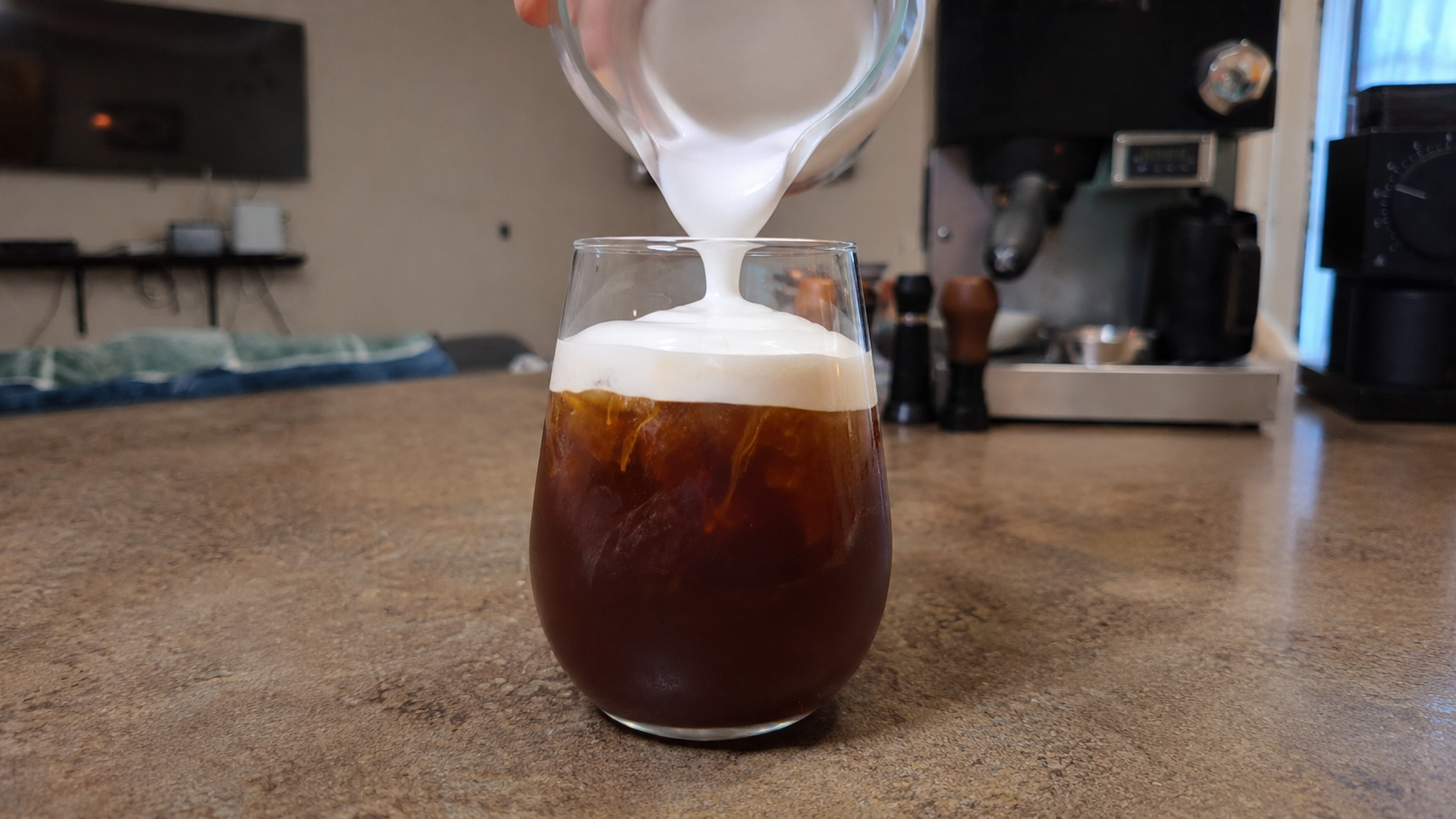
I have a handheld wand, this frother, and an espresso machine with a real steam wand sitting on the same counter. That makes the comparison unusually concrete. Since writing this, I've also tested it head-to-head against the Bodum Bistro — short version: the Bodum makes better hot foam and feels better built, but the Instant keeps the cold-foam mode and the bigger capacity.
| Instant Frother | Zulay Handheld | Steam Wand (on an espresso machine) | Breville Milk Café | |
|---|---|---|---|---|
| Price | ~40 | ~7 | Part of a 250+machine | ~150 |
| Type | Automatic jug | Handheld wand | Manual steam | Automatic jug |
| Heats the milk | Yes | No | Yes | Yes |
| Cold foam | Yes | Yes, with effort | No | Yes |
| Latte art | No | No | Yes | Limited |
| Hands-off | Yes | No | No | Yes |
| Capacity | 10 oz | Any vessel | Any pitcher | 25 oz |
| Temperature control | No | n/a | You control it | Yes |
Against the Zulay handheld. These aren't really competitors, and I'd push back on anyone framing them that way. The Zulay is $7 and it whisks — it does not heat your milk, which means you're microwaving first and guessing at temperature. The Instant heats, textures, and stops on its own. If you make one drink a day and don't mind the extra step, the Zulay is still an absurd bargain. If you make milk drinks every morning, the $33 difference buys back a step and a guess every single time.
Against a real steam wand. No contest on quality, and I'd rather say that plainly than pretend otherwise. Steam injects and stretches milk in a way whisking cannot replicate — that's why latte art is possible with one and impossible with the other. But a steam wand requires an espresso machine, a pitcher, and a skill you have to build. This is a button. Different tools for different mornings, and I use both.
Against the Breville Milk Café. The Breville is roughly four times the price and it earns some of that — 25oz capacity, adjustable temperature, better foam. If you're making drinks for a household every morning, it's the better machine. For one or two drinks with no temperature fussing, the gap narrows a lot.
☕ The Former-Barista Verdict
I'd buy it again. After a few weeks it's earned permanent counter space, which is the only test that really matters for a $40 appliance — it gets used every morning instead of living in a cupboard. The cold foam is excellent, it's near-silent, the thick foam is genuinely dense rather than bubbly, and the whole thing takes about a minute with no attention from me.
The one real criticism is temperature. At 155–158°F it finishes hotter than milk tastes best at, there's no setting to change that, and the fix is to interrupt the cycle early — which slightly undercuts the point of an automatic machine. It's a small annoyance rather than a dealbreaker, but it's the reason this isn't a 10.
Buy it if you make milk drinks at home without an espresso machine, and especially if you drink iced coffee. Skip it if you already own a machine with a decent steam wand.
I bought this frother with my own money. Coffee Slang earns a small commission if you buy through this link, at no extra cost to you.
Buy it if you make lattes, cappuccinos, or iced coffee at home and don't have an espresso machine with a steam wand. Buy it if you drink cold foam drinks, because that mode alone is worth the price gap over a handheld. Buy it if you're tired of microwaving milk and guessing, or if you're making drinks for someone who wants hot chocolate as often as coffee.
Skip it if you already own an espresso machine with a decent steam wand — you'd be buying a worse version of something on your counter. Skip it if latte art matters to you, because no automatic frother will get you there. Skip it if you're frothing almond milk primarily, or if you regularly make drinks for more than two people, where the 10oz jug becomes the bottleneck.
The Instant Milk Frother isn't trying to replace a steam wand, and judging it against one misses the point. It's trying to remove the steps between you and a milk drink on a weekday morning, and at around $40 it does that well enough that it earned counter space next to gear that cost a lot more.
The cold foam mode is what makes it worth owning over a cheap handheld wand, and the near-silent operation is what makes it pleasant to own. Running at 155–158°F with no way to dial it back is the one thing keeping it from a perfect score — learn to stop the cycle a few seconds early and you've solved most of it.
If you're building out the rest of the setup, our best milk frothers guide covers the full range from $7 wands to full automatic jugs, and why your milk won't froth is worth reading regardless of which one you own — most foam problems are the milk, not the machine.

Former barista. Lifelong coffee obsessive. I started Coffee Slang to cut through the noise and share what actually matters — good recipes, honest gear takes, and a genuine love for the craft.
More About Nick →