

This post contains affiliate links. If you purchase through our links, we may earn a small commission at no extra cost to you.
At under $7, the Zulay Kitchen handheld milk frother is one of the most recommended budget frothers you'll find — and it shows up in nearly every conversation about getting café-quality foam at home without spending much. Nearly 94,000 Amazon reviews at 4.3 stars isn't luck. It means a lot of people bought it, used it, and thought it was worth rating.
That said, numbers aren't a review. In this post I'm breaking down exactly what you get with the Zulay, where it performs well, and where you'll hit its limits — so you can decide if it fits your setup. If you're still weighing your options more broadly, our guide to the best milk frothers for home use compares it alongside electric and automatic models at every price point.
A handheld milk frother — sometimes called a frother wand or milk wand — is a battery-powered tool with a spinning coil at the tip that aerates milk by agitating it rapidly. You submerge the whisk just below the surface of your milk, switch it on, and move it in a slow circle. Air gets worked in, and within 15–20 seconds you have foam.
The Zulay is that tool stripped down to its essentials. One button. One speed. A stainless steel coil with 25 rings, a nylon handle, and a small stand so it doesn't roll off the counter. It runs on two AA batteries and doesn't need charging, descaling, or much thought. That simplicity is part of why it sells so well — there's nothing to break down or figure out.
It's worth being clear about what a wand frother is not. It won't heat your milk. It won't produce the tight, dense microfoam you'd get from an espresso machine's steam wand. What it does is create light, airy foam — enough for a cappuccino or latte at home — in under a minute.
The body is matte nylon with a narrow grip — narrower than some competitors, which actually helps when you're working in a small mug or milk pitcher. The whisk connects via a simple metal collar and feels secure. The included plastic stand keeps it upright when it's not in use, which is a small detail a lot of frothers skip.
The stainless steel is described as rust-resistant, and in practice that holds up. A frother that gets rinsed every day needs to handle moisture without corroding, and the Zulay does that reliably. The nylon handle isn't premium, but it isn't pretending to be. For a $7 tool, the construction is appropriate and functional.
One design trade-off worth knowing: the on/off button is a push toggle, not a hold-to-operate trigger. That means if you accidentally set it down mid-froth, it stays running. Not a major issue, just something to be aware of.
The 13,000 RPM motor is lower than some competitors that advertise 19,000+ RPM, but RPM alone doesn't tell the whole story. The 25-ring whisk design compensates by pulling more surface area through the milk on each rotation. In testing across whole milk, oat milk, and almond milk, foam build-up starts within about 5 seconds and reaches usable volume by the 15–20 second mark.
Whole milk produces the most consistent results — you get a solid layer of foam with medium-fine bubbles that hold their shape for a couple of minutes. It's not steam-wand microfoam, but it's more than adequate for home lattes. The pour isn't perfect latte art, but it layers correctly.
Plant-based milks work, with caveats. Standard supermarket oat milk and almond milk produce larger, less stable bubbles regardless of which frother you use — that's a property of the milk, not the frother. Barista-edition oat milk (Oatly Barista, Califia Farms Barista) performs noticeably better because of the added fat and stabilizers. If oat milk foam keeps disappointing you, that's likely the issue.
The single-speed motor is the main functional limitation. There's no dial for foam density — you control that entirely through technique. Move the wand slower and shallower for more foam; faster and deeper for less foam, more integrated texture. It's learnable, but expect a small learning curve if you're coming from a frother with adjustable settings.
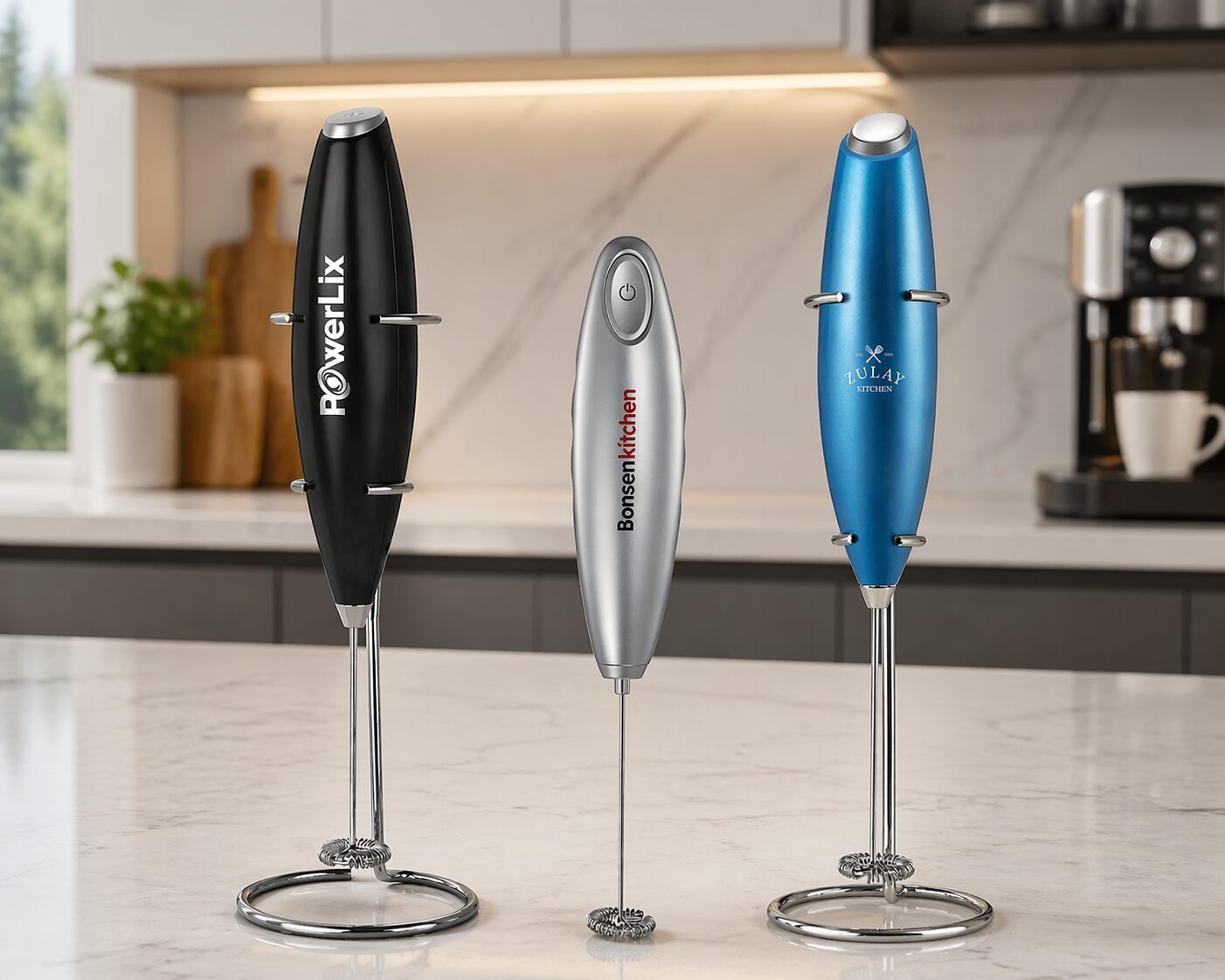
The handheld frother market at this price point is crowded. Here's how the Zulay stacks up against two of its most common competitors:
| Frother | Motor Speed | Power | Guarantee | Approx. Price |
|---|---|---|---|---|
| Zulay Kitchen | 13,000 RPM | 2 AA batteries | Lifetime | ~$7 |
| PowerLix | 19,000 RPM | 2 AA batteries | None listed | ~$8–9 |
| Bonsenkitchen | 12,500 RPM | 2 AA batteries | 12 months | ~$9–10 |
The PowerLix has a higher RPM rating and is a legitimate competitor, but it costs a dollar or two more and carries no stated warranty. The Zulay's lifetime guarantee is a real differentiator at this price — if the motor dies in six months, you contact Zulay and they replace it, even after the Amazon return window closes. That matters when you're spending $7.
For a broader look at how handheld wands compare to electric and automatic frothers, our piece on handheld vs. electric milk frothers covers the key differences in foam quality, price, and use case.
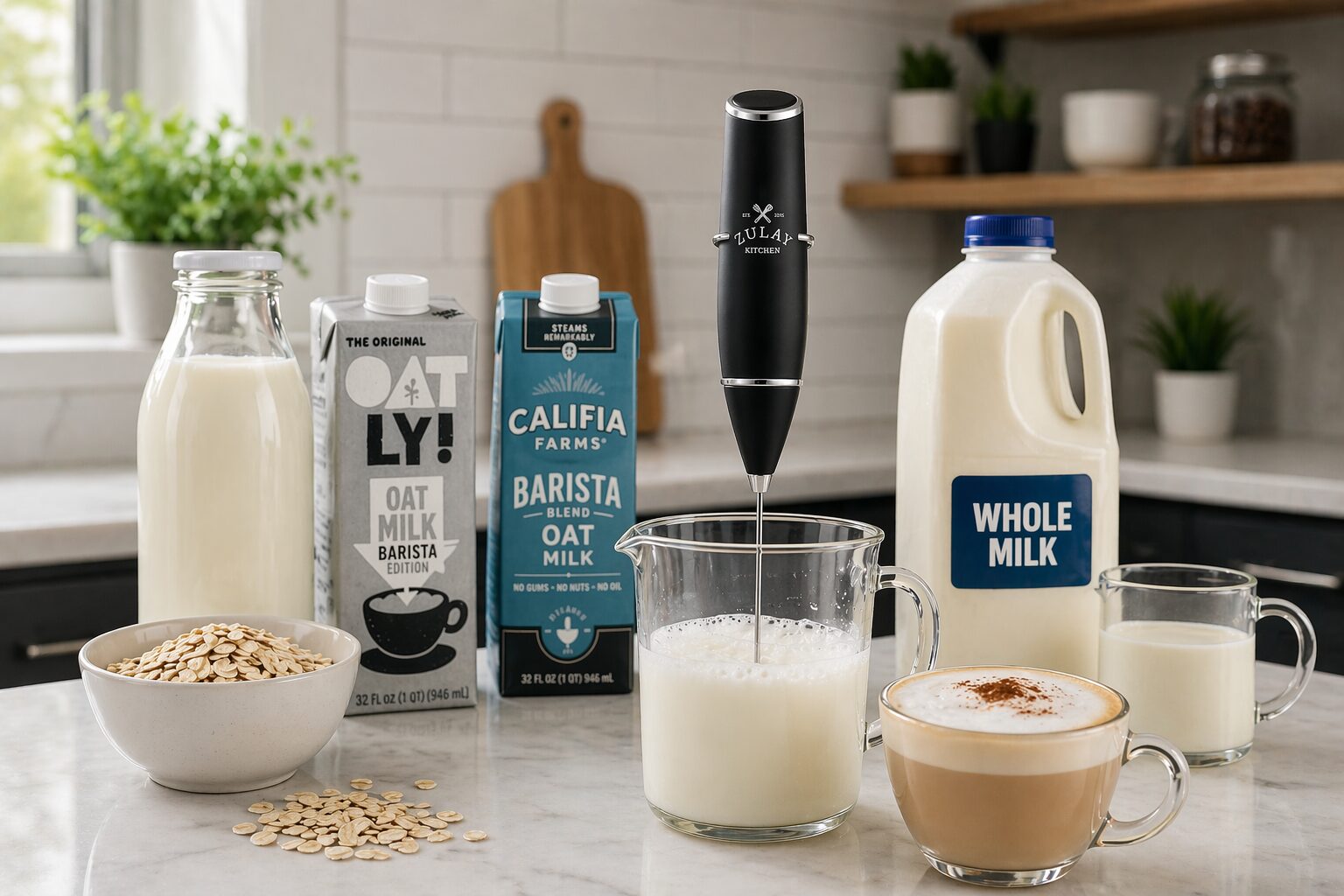
Cold whole milk is the easiest place to start. The fat content gives you stable foam with a relatively fine bubble structure, and it holds up in the cup long enough to drink comfortably. If you're pulling espresso or using strong moka pot coffee underneath, whole milk is the default that'll behave most predictably.
For non-dairy options, barista-edition oat milk is the best substitute. Brands like Oatly Barista and Califia Farms Barista are formulated with added fat and stabilizers specifically so they froth closer to dairy. Standard shelf oat milk and almond milk will still work, but the foam will be looser and won't last as long — that's a milk issue, not a frother issue.
Soy milk froths reasonably well but tends to deflate faster than dairy. Cream and half-and-half work great if you're making something richer — the Zulay handles those without issue. For a flat white, where you want a silkier, less airy texture, reduce the frothing time to around 8–10 seconds and keep the wand a bit deeper in the milk.
The most common mistake with a wand frother is submerging it too deep. When the whisk is buried in the milk, it spins the liquid without working in much air — you get warm, frothy milk at best. The technique that works is keeping the coil just below the surface, about 1cm down, and moving it in a slow circle so the spinning pulls air in from the top.
Once you have visible foam building — usually around 8–10 seconds — move the wand slightly deeper to blend the foam into the milk below it. This gives you a more integrated texture rather than a separate cap of dry foam sitting on top. The whole process is 15–20 seconds for a standard cappuccino or latte.
For a cappuccino, froth longer and shallower to build more volume — you want a higher foam-to-milk ratio. For a latte, froth shorter and keep the wand deeper so the texture stays creamy rather than bubbly. The single-speed motor means all of this variation comes from your technique, which takes a session or two to get consistent.
The Zulay markets itself for protein powder, matcha, and hot chocolate, and those aren't just filler claims. The frother genuinely handles matcha well — it disperses the powder into liquid cleanly without clumps, which is one of the more annoying problems to solve with matcha by hand. Whisk directly in the cup for about 10 seconds and the powder integrates.
Hot chocolate made by stirring in cocoa powder or a chocolate syrup into hot milk benefits from a 10-second froth at the end — it produces a light foam on top that most people find more appealing than flat hot chocolate. Lighter protein powders mix fine; thick, gummy protein shakes may overwork the motor and aren't the ideal use case.
Zulay also mentions whisking eggs and salad dressings, and while it works in a pinch, a small whisk does that job better. Stick to beverages and you'll get the most out of it.
Most issues with the Zulay come down to a small set of fixable problems. If your foam is thin or collapses quickly, the milk is likely too warm or too low in fat — chill it before frothing and try whole milk or barista-edition oat milk. If the motor sounds sluggish or slower than when you first got it, replace both batteries. A gradual slowdown is almost always low power, not a failing unit.
Milk splashing is usually a sign the whisk is too close to the surface. Submerge it at least a centimeter below and ease into the circular motion rather than starting fast. If you're getting big, unstable bubbles that don't hold, you're likely working too fast near the surface — slow down and keep the tip a little deeper once foam starts building.
For a deeper dive into why milk sometimes won't foam regardless of technique or frother, our milk frothing troubleshooting guide covers the full list of variables — milk type, temperature, fat content, and age. And if you want to keep the whisk performing at its best, the milk frother cleaning guide has the right routine for a wand frother specifically.
At around $7 with a lifetime guarantee and nearly 94,000 reviews behind it, the Zulay Kitchen handheld frother earns its reputation. The 13,000 RPM motor and 25-ring whisk produce honest foam in under 20 seconds, it works across dairy and non-dairy milks, and the single-button operation means there's nothing to figure out. It won't replicate a steam wand, and the single speed puts the responsibility for foam quality on your technique — but that's inherent to the format, not specific to this frother.
If you want a no-fuss, inexpensive way to add foam to your morning coffee, this is the one most people reach for, and the volume of satisfied buyers suggests it's not by accident. If you find yourself wanting more precision, more volume, or automatic heating, that's the point where stepping up to an electric frother makes sense. My pick for that jump is the $30 Bodum Bistro — one switch, hot foam that actually holds, and no technique required.

Former barista. Lifelong coffee obsessive. I started Coffee Slang to cut through the noise and share what actually matters — good recipes, honest gear takes, and a genuine love for the craft.
More About Nick →